How to teach telling time, one hand at a time
October 20, 2026 · 7 min read
Telling time looks like one skill and is really three: reading the hour hand, counting the minute hand by fives, and holding both at once. Children struggle when all three arrive together. Taught one at a time, most get it in a few weeks.
Step 1: the hour hand alone
Take the minute hand out of the picture. Use a toy clock and remove it, or cover it with a finger. "The short hand is pointing at the 4. It is about four o'clock." When the short hand is between two numbers, it is after the smaller one: between the 4 and the 5 is "after four."
Lifehack: say "about" on purpose. "It's about four" is the right answer for an hour hand alone, and it makes the minute hand feel like the thing that makes it exact.
Step 2: o'clock and half past
Bring the minute hand back, but only at the top and the bottom. At the 12, it is o'clock. At the 6, it is half past, and the hour hand is halfway between two numbers. This is the first-grade standard (1.MD.3), and it is worth staying here until it is easy.
Step 3: counting by fives
The minute hand needs a different kind of reading: every number is five more minutes. Count around the face together — 5, 10, 15, 20 — then let the child count while you point. Quarter past and quarter to belong here: a quarter of the way around is 15 minutes.
Step 4: both hands together
Now read the hour first, then the minutes: "The short hand is past the 2, the long hand is on the 7 — 2:35." Second graders are expected to read to five minutes (2.MD.7); third graders to the exact minute (3.MD.1).
Step 5: turn it around
Reading a clock and setting one are different skills. Once reading is easy, switch to drawing the hands for a time. It is harder — the hour hand has to sit in the right place between two numbers — and it is what makes the skill stick.
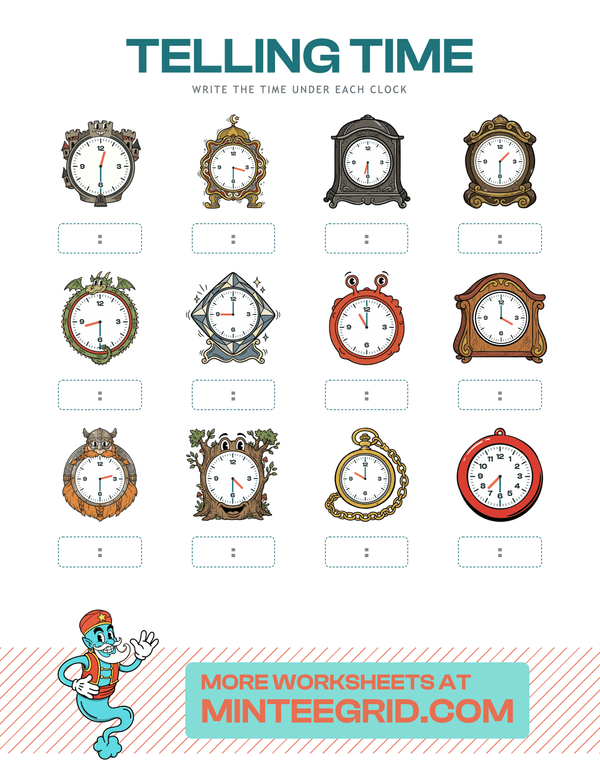
Our Telling Time generator has a sheet for each step: read the clock, draw the hands, match clocks to digital times, time in words, and elapsed time, each at the hour-and-half-hour, five-minute or minute level.
Try it yourself
Telling Time
Read the clock, draw the hands, match, time in words, elapsed time — on themed clocks. Math · 6–9 years.
The mistakes to expect
- Hands read backwards — "five o'clock" for 1:25. Name the hands by job, and color them.
- The hour too early — at 2:50 the short hand is almost on the 3, and children say "three-fifty." Ask: "Has it reached the 3 yet?"
- Counting minutes by ones — the minute hand on the 4 read as "4 minutes." Go back to counting by fives.
A few clocks every day beat a long session once a week. For a game that does the practice for you, see Clock Bingo; for a.m. and p.m., see a.m. and p.m. explained.
FAQ
What is the best way to teach a child to tell time?
Teach the hour hand alone first, then o'clock and half past, then counting by fives around the face, and only then put the two hands together. Practice a few clocks a day rather than a long session once a week.
How do I explain the minute hand to a child?
Tell them the minute hand counts by fives: each number it points to is five more minutes. Count around the face together — 5, 10, 15 — until they can do it without you.
Why does my child read the hands backwards?
Because both hands point at numbers and the child reads whichever one they see first. Name the hands by job (hour, minute) rather than size, and use clocks where the hands are different colors.