Long division steps that stick: divide, multiply, subtract, bring down
October 12, 2026 · 7 min read
Long division is four steps on repeat: divide, multiply, subtract, bring down. That's all it is. Children don't get lost because the steps are hard — each one is something they already know. They get lost because the steps loop, the page fills up, and one misplaced digit wrecks everything after it.
The four steps, with a real problem
Take 754 ÷ 6.
- Divide. How many times does 6 go into 7? Once. Write 1 above the 7.
- Multiply. 1 × 6 = 6. Write it under the 7.
- Subtract. 7 − 6 = 1.
- Bring down the next digit, 5. Now you have 15.
Repeat. 6 into 15 goes 2 times (12). 15 − 12 = 3. Bring down the 4: 34. 6 into 34 goes 5 times (30). 34 − 30 = 4. No digits left, so 4 is the remainder.
754 ÷ 6 = 125 r 4.
Lifehack: "Does McDonald's Sell Cheeseburgers?" — Divide, Multiply, Subtract, Check, Bring down. The "check" step is the important addition: after subtracting, the result must be smaller than the divisor. If it isn't, the quotient digit was too small.
Trick 1: write the multiples first
Most long division errors are guessing errors: "how many 7s in 52?" Guess 8, multiply, get 56, too big, erase, try again. That's where the frustration lives.
Lifehack: before starting, write the divisor's multiples in the margin: for 7, that's 7, 14, 21, 28, 35, 42, 49, 56, 63. Now every "divide" step is a lookup, not a guess. It takes thirty seconds and removes most of the erasing.
Trick 2: graph paper
Every step of long division depends on columns lining up. A child who writes the 12 one place too far left subtracts the wrong digits and gets a nonsense answer — and the error looks like a division mistake when it's really a handwriting one.
Quarter-inch graph paper, one digit per square, fixes this almost completely. It's how most US classrooms do it, and it's how our long division sheets are laid out.
Trick 3: estimate before you start
754 ÷ 6: 6 × 100 = 600 and 6 × 200 = 1,200, so the answer is between 100 and 200. If the child ends up with 12 or 1,250, they know immediately something went wrong — usually a missing zero or a skipped "bring down."
The mistakes worth watching for
- The missing zero. 618 ÷ 6: 6 into 6 is 1, bring down the 1 — 6 doesn't go into 1. Children skip writing the 0 in the quotient and get 13 instead of 103. Rule: every bring down puts a digit in the answer, even if it's 0.
- Remainder bigger than the divisor. A remainder of 8 when dividing by 6 means one more 6 fit. The "check" step catches this.
- Starting in the wrong place. If the divisor doesn't go into the first digit, the first quotient digit goes above the second digit.
How to practice
Start with one-digit divisors and no remainders, so every problem ends cleanly. Then remainders. Then two-digit divisors, which are a real jump — the multiples list becomes essential there. Our generator can write remainders as r, as a fraction, or as a decimal, and the answer key shows every step of the working, so a parent can find the exact line where it went wrong.
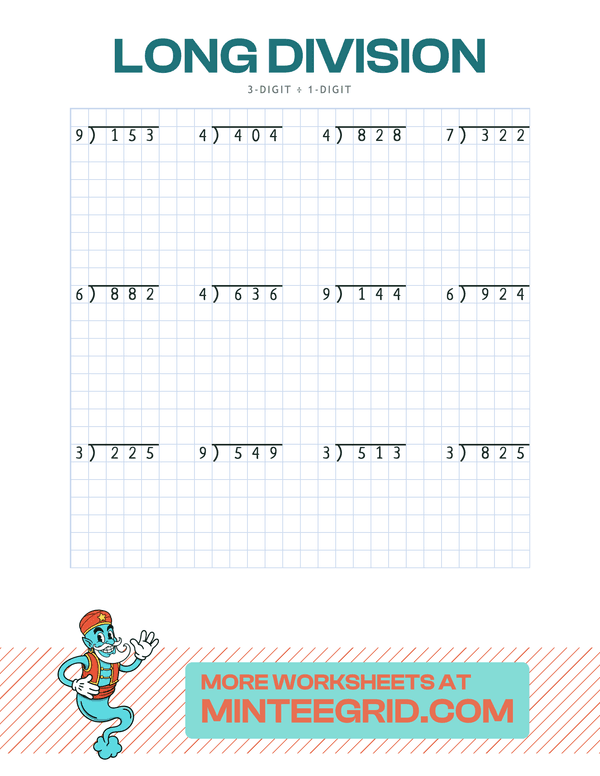
Try it yourself
Long Division
The American bracket on quarter-inch graph paper, with every step of the working in the answer key. Math · 9–12 years.
If the multiplication facts underneath are shaky, fix those first — every "divide" step is a multiplication fact in disguise. Division facts sheets and how to memorize the times tables are the place to start.
FAQ
What are the steps of long division?
Divide, multiply, subtract, bring down — then repeat until there are no digits left to bring down. Divide: how many times does the divisor go into the current number? Multiply: that digit times the divisor. Subtract: take the product away. Bring down: the next digit of the dividend.
What is a mnemonic for long division?
'Does McDonald's Sell Cheeseburgers?' — Divide, Multiply, Subtract, Check, then Bring down. Some teachers use 'Dad, Mom, Sister, Brother' for divide, multiply, subtract, bring down. Either one keeps the order.
What grade learns long division?
Fourth grade divides up to four-digit numbers by one-digit divisors (4.NBT.6). Fifth grade divides by two-digit divisors (5.NBT.6), and sixth grade is expected to be fluent with the standard algorithm (6.NS.2).
What should my child do when the divisor doesn't go into the first digit?
Use the first two digits instead. In 156 ÷ 6, 6 doesn't go into 1, so ask how many times 6 goes into 15. Write the first quotient digit above the 5, not above the 1.