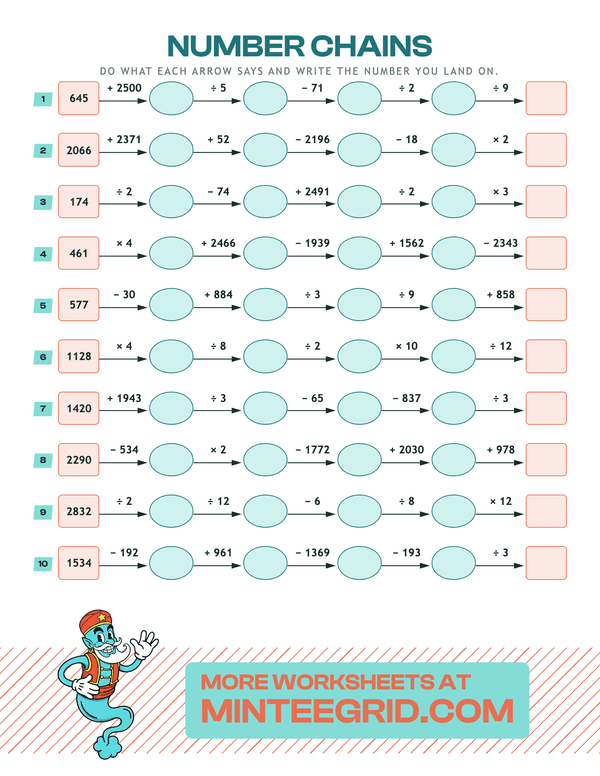
Five operations in a row, each one starting from the last answer
A page of separate sums lets a child stop after each one. A chain does not: the answer to step two is what step three is done to, so the row has to be held together from one end to the other. It is the same arithmetic and a different kind of attention.
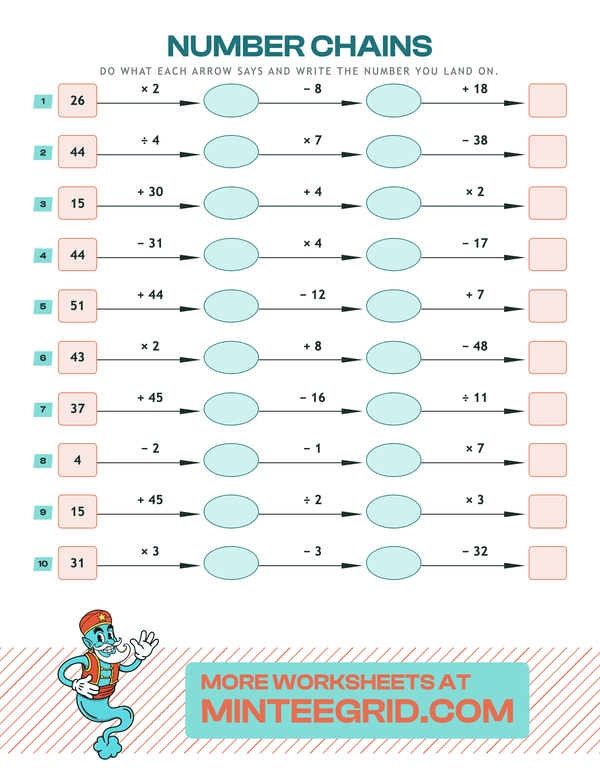
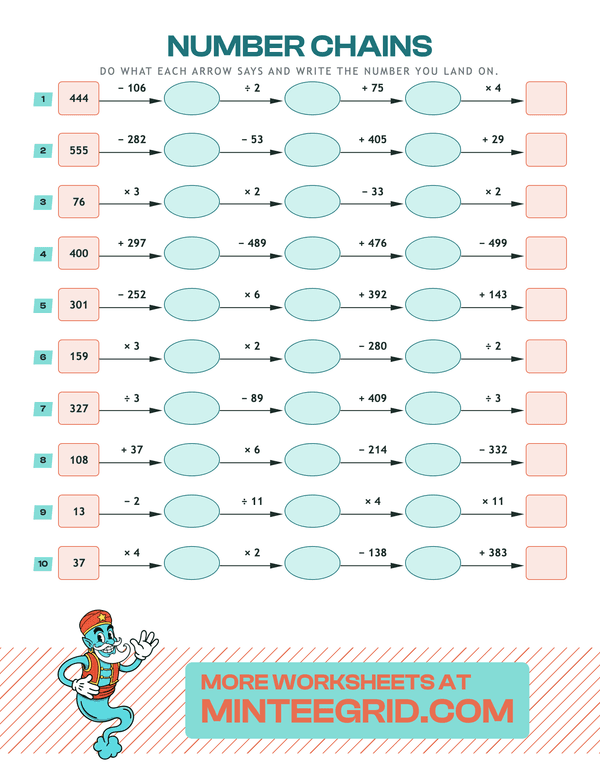
The answer to this one is where the next one starts.
A number chain worksheet generator, printable as a PDF. Set the ceiling — 20, 100, 500, 1,000, 5,000 or anything you type — pick three, four or five arrows to a row, and generate. The first number is printed, every arrow carries its own operation, and the child writes each number they land on. Nothing goes below 1 or above your ceiling anywhere in the chain, and every division is exact, so there is never a remainder or a negative in the middle of a row. Ten chains a sheet, with an answer key.
1 token a sheet, fewer in batches.
US Letter PDF — prints on any home printer.
Start
From the printed number at the head of the row.
Do
Whatever the arrow says — it carries its own operation.
Carry on
Write where you landed, and work from there to the end.
Numbers up to
Every number on the sheet stays between 1 and this, all the way through the chain — nothing negative, and every division comes out exactly.
Arrows in a row
Every row uses at least two different operations, and no operation runs three times.
Your worksheet lands here — download, print, or email it.