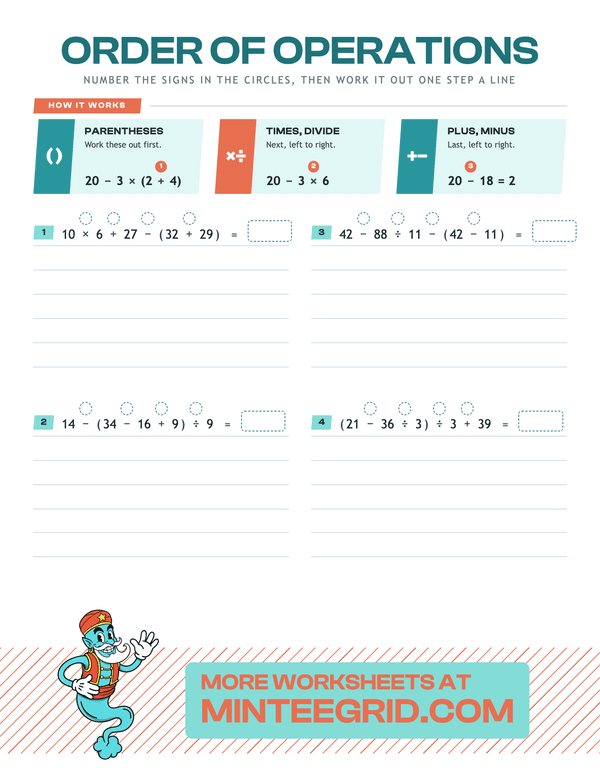
Decide the order first, then do the math
Every problem on this sheet gives a different answer if it is worked straight through from left to right — so the only way to get it right is to know the rule. A small circle over each sign is where the child numbers the order before calculating anything.
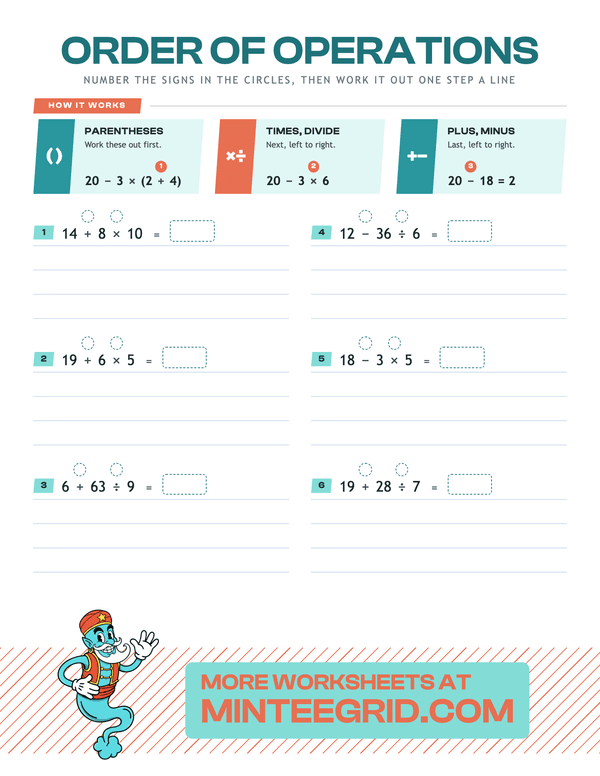
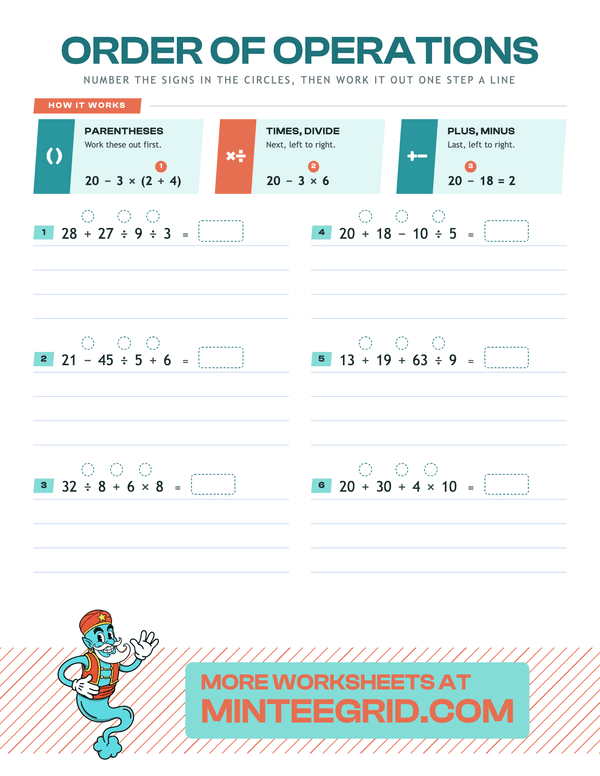
Parentheses, then times and divide, then plus and minus.
An order of operations worksheet generator, printable as a PDF. Pick two, three or four steps a problem and generate. Two-step problems have no parentheses, three-step ones have them half the time, and four-step ones always do — and the parentheses always change the answer. Every number stays whole and positive, every division comes out exact, and every multiplication stays on the times tables, so the page practices the order rather than the arithmetic. Each problem has ruled lines underneath, one step to a line, and the answer key writes every step out. The worked example at the top walks one problem through the rule — parentheses, then multiplication and division, then addition and subtraction — and can be switched off. For a child who has the rule and needs the stamina, a big-numbers level asks three steps on numbers up to five digits — 24,763 − 1,696 ÷ (132 − 100) — with quarter-inch graph paper under each problem for the long division and multiplication.
1 token a sheet, fewer in batches.
US Letter PDF — prints on any home printer.
Number
Write 1, 2, 3 in the circles over the signs, in the order they are done.
Work
Do one step a line, in that order, carrying each answer forward.
Answer
The last line is the answer. Write it in the box.
Steps in each problem
Two steps have no parentheses; three have them half the time; four always do. Big numbers is three steps on five-digit numbers — a long division or multiplication in each — worked on graph paper, three a page. Every problem comes out differently if it is worked straight through, left to right.
Your worksheet lands here — download, print, or email it.