A short history of clocks, for kids and the grown-ups who get asked
October 20, 2026 · 7 min read
Every clock on the wall carries a few thousand years of history: twelve numbers from ancient Egypt, sixty minutes from Babylon, and a direction borrowed from a shadow. Here is the story, short enough to read to a six-year-old who has just asked "why?"
Shadows: the sundial
The first clocks were shadows. Put a stick in the ground, and its shadow swings around as the sun crosses the sky. The ancient Egyptians marked where the shadow fell and split the daylight into twelve parts — the beginning of our twelve hours. A sundial has one problem anyone can spot: it stops working when the sun goes in.
Try it: stand a pencil in a lump of clay on a sunny windowsill and mark its shadow every hour. By evening you have a sundial — and a good reason to know why the shadow moves.
Water: the clepsydra
For cloudy days and nights, people used water clocks: a bowl with a small hole, and lines inside to show how far the water had dropped. Ancient Greeks timed speeches in court with them, so no one could talk for too long.
Sixty: a number from Babylon
The Babylonians counted in sixties, because sixty splits evenly so many ways — in halves, thirds, quarters, fifths, sixths. Their sixties stayed with us: 60 minutes in an hour, 60 seconds in a minute, and 360 degrees in a circle.
Gears: the first mechanical clocks
About seven hundred years ago, clocks with gears and weights appeared in church towers in Europe. Many had no face at all — they just rang a bell every hour. Our word "clock" comes from an old word for bell. Faces came later, often with only an hour hand, because the clocks were not accurate enough for minutes to matter.
Swing: the pendulum
In 1656, a Dutch scientist named Christiaan Huygens built a clock with a pendulum, after Galileo noticed that a swinging weight keeps a steady beat. Suddenly clocks were accurate to a minute a day, and the minute hand became worth having. Grandfather clocks are pendulum clocks with a tall case to hide the long swing.
Cuckoo: a clock that sings
In the Black Forest of Germany, clock makers added a little bird that pops out and calls the hour. Cuckoo clocks are still made there, and children still wait for the bird.
Pockets and wrists
Small springs made clocks small enough to carry: first pocket watches on chains, then wristwatches, which soldiers wore because a pocket was too slow to reach. Today the most accurate clocks count the vibrations of atoms — but the face on the classroom wall still looks almost exactly like a clock from three hundred years ago.
Bring it to the table
Our Telling Time sheets are drawn on clocks from all of this history — pocket watches, cuckoo clocks, mantel clocks, alarm clocks with bells — so a child can point at one and say what kind it is before reading what time it shows.
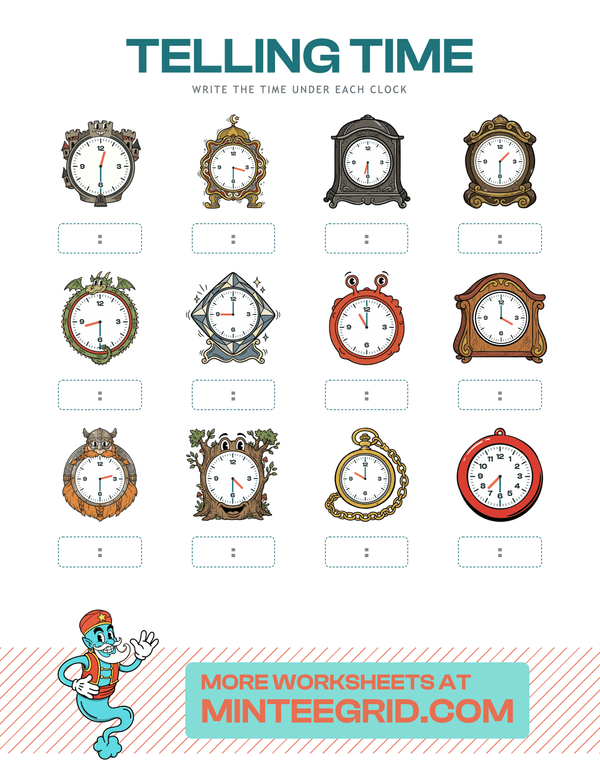
Try it yourself
Telling Time
Read the clock, draw the hands, match, time in words, elapsed time — on themed clocks. Math · 6–9 years.
For why the analog face is still worth learning, see why kids should still learn to read an analog clock.
FAQ
Why are there 60 minutes in an hour?
Because of the ancient Babylonians, who counted in sixties. Sixty divides evenly by 2, 3, 4, 5, 6, 10, 12, 15, 20 and 30, which made it handy for splitting things up, and the habit stayed with us for minutes, seconds and the degrees of a circle.
Why do clocks have 12 numbers?
Ancient Egyptians split daylight into 12 parts and the night into 12 more. Clocks show one half of the day at a time, so the hand goes around twice a day — once for a.m. and once for p.m.
Why do clocks go clockwise?
The first clocks copied sundials, and in the northern hemisphere a sundial's shadow moves from left to right across the top. Clock makers kept the same direction, and that is what we now call clockwise.