Why kids should still learn to read an analog clock
October 20, 2026 · 6 min read
A child can read 3:45 off a phone without understanding anything about it. Ask how long until four o'clock and the digits do not help. On a clock face, the answer is right there: the long hand has a quarter of the way to go. That is the real reason American schools still teach analog clocks — and why it is worth doing at home too.
What a clock face teaches that digits do not
Time as an amount. On a clock face, twenty minutes is a slice you can see. A child who has watched the long hand sweep from the 12 to the 4 knows what twenty minutes feels like on the page. Digits only tell you where you are, not how far you have to go.
Fractions, before fractions. "Half past" is half of the circle. "Quarter to" is the last quarter. The clock is the first place most children meet halves and quarters as parts of a whole — long before a fraction worksheet.
Skip counting with a purpose. The minute hand pointing at the 7 means 35 minutes, and the only way to get there is counting by fives. Clocks turn skip counting from a chant into a tool.
Elapsed time. "We leave in forty minutes" makes sense on a clock face. Third graders are expected to solve elapsed-time problems, and the face is where that thinking happens.
Where it is in the standards
Telling time is not optional in US schools. The Common Core standards put it in three grades:
- First grade (1.MD.3): hours and half hours on analog and digital clocks.
- Second grade (2.MD.7): to the nearest five minutes, with a.m. and p.m.
- Third grade (3.MD.1): to the nearest minute, and elapsed time.
Lifehack: put a real analog clock where your child can see it from the breakfast table. Ask one question a day — "Where will the long hand be when we leave?" — and nothing else.
How to start
- Only the short hand first. Cover the long hand, or use a clock with one hand. "The short hand is near the 3, so it is about three o'clock."
- Then the long hand on the 12 and the 6. O'clock and half past, nothing else, until both are easy.
- Then count by fives. Point at each number and count 5, 10, 15 around the face.
- Then match to digital. Put a clock beside the digital time and say both out loud.
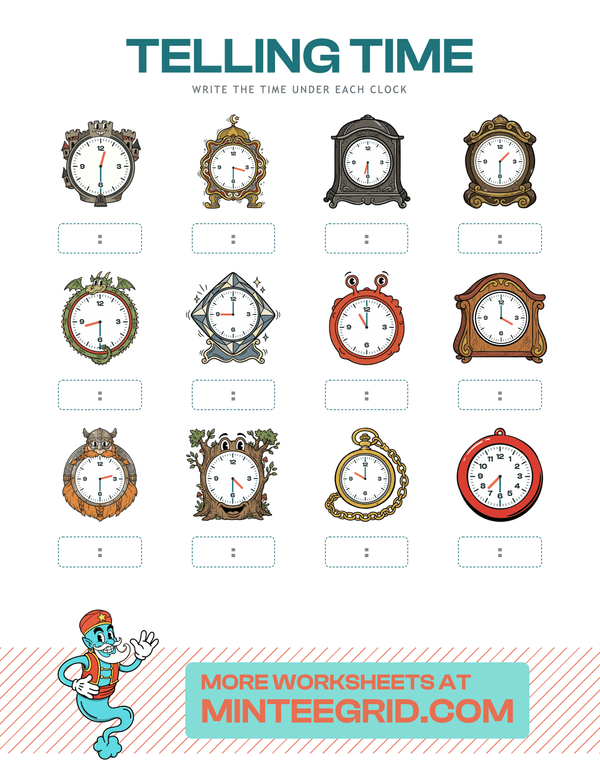
Our Telling Time sheets follow exactly that order: hour and half hour first, then five minutes, then the minute — on clocks shaped like pumpkins, pocket watches and clocks with arms and legs, so twelve clocks on a page do not feel like twelve of the same exercise.
Try it yourself
Telling Time
Read the clock, draw the hands, match, time in words, elapsed time — on themed clocks. Math · 6–9 years.
The mistake to watch for
The most common mix-up is reading the hands the wrong way round: the long hand on the 3 and the short one near the 8 read as "three eight." Name the hands by job, not size — "the hour hand" and "the minute hand" — and color them, as our sheets do: orange for the hour, green for the minutes.
For a whole-class game once the basics are in, try Clock Bingo. For the history of how we ended up with twelve numbers and two hands, see a short history of clocks for kids.
FAQ
Do kids still need to learn analog clocks?
Yes. Telling time on an analog clock is part of the US math standards in first, second and third grade (1.MD.3, 2.MD.7, 3.MD.1), clocks still hang in every classroom, and the clock face teaches fractions, skip counting by fives and elapsed time in a way digital numbers cannot.
At what age can a child read a clock?
Most children can read the hour and half hour around six or seven, five-minute times around seven or eight, and the exact minute around eight or nine. Children who practice a little every day often get there sooner.
Is a digital clock easier to learn first?
It is easier to read aloud, but it teaches less. A child can say 2:45 from a digital display without knowing it means a quarter of an hour before three. Learning the analog face first, and matching it to digital times, gives both.