Arrays: how repeated addition turns into multiplication
October 12, 2026 · 6 min read
An array is objects in equal rows and columns — three rows of four dots, say. It's the bridge between two ideas a second grader already half-knows: adding the same number over and over (4 + 4 + 4) and multiplying (3 × 4). One picture, both sentences.
Why arrays and not just groups?
You can show multiplication with groups — three plates of four cookies. Arrays do something groups can't: turn the page sideways and three rows of four become four rows of three. Same dots. So 3 × 4 = 4 × 3, and the child can see it rather than take it on faith.
That matters because it halves the times tables. A child who believes 7 × 8 and 8 × 7 are the same fact only has to learn one of them.
Lifehack: draw an array on a sticky note and rotate it 90 degrees in front of your child. "Was it 3 rows of 4? Now it's 4 rows of 3. Did any dots disappear?" One rotation teaches the commutative property better than any explanation.
Arrays are everywhere in your kitchen
- Egg cartons: 2 rows of 6. A dozen is 2 × 6.
- Muffin tins: usually 3 rows of 4, or 4 × 6 for big ones.
- Ice cube trays, chocolate bars, window panes, a sheet of stickers.
Lifehack: at the store, ask "how many eggs without counting one by one?" Children who count rows — "six, twelve" — are already multiplying. Children who count every egg aren't there yet, and that's useful to know.
How should a child practice arrays?
The steps follow the grades:
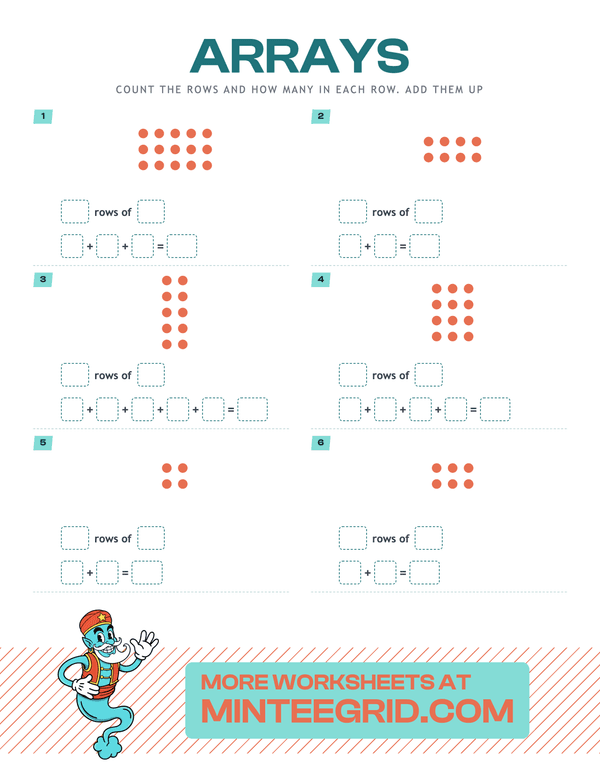
- Repeated addition (second grade). Up to 5 rows of 5. Count the rows, count how many in one row, write the addition: 4 + 4 + 4 = 12. One addend for every row.
- Multiplication sentences (third grade). Up to 10 by 10. Rows × in each row = total: 3 × 4 = 12.
- Draw the array. Given 4 × 6, draw it. This reverses the skill and checks that the child knows which number is rows and which is columns.
Our arrays sheets have all three modes, six arrays a page, and they never put a fact and its turnaround on the same sheet — so 3 × 4 and 4 × 3 are something to notice on the next sheet, not a repeat on this one.
Try it yourself
Arrays
Dots in rows and columns: write the repeated addition, the multiplication fact, or draw the array. Math · 7–9 years.
The mistakes to watch for
- Counting every dot. It gets the right answer and misses the point. Cover all but one row and ask how many in that row; then ask how many rows.
- Mixing rows and columns. Remind: rows go across like a row of seats, columns go down like a column holding up a roof.
- Wrong number of addends. 3 rows of 4 written as 4 + 4 + 4 + 4. Have the child point to one row for each 4 they write.
Where arrays lead next
Arrays come back in fourth grade as the area model for multi-digit multiplication — a big rectangle split into parts — and again for area in square units. A child comfortable with dot arrays meets both as old friends.
When the facts themselves need drilling, multiplication fact sheets and how to memorize the times tables pick up where arrays leave off.
FAQ
What is an array in math?
An array is a set of objects arranged in equal rows and columns. Three rows of four dots is a 3 by 4 array; it shows 4 + 4 + 4 = 12 and 3 × 4 = 12.
What grade learns arrays?
Second grade uses arrays with up to 5 rows and 5 columns to write repeated addition (2.OA.4). Third grade uses them to understand multiplication as equal groups (3.OA.1) and to see the commutative property (3.OA.5).
Do rows or columns come first?
Rows first in US classrooms: 3 × 4 is read as 3 rows of 4. Rows go across, columns go down. The total is the same either way, which is exactly what the commutative property says.
Is repeated addition the same as multiplication?
For whole numbers, yes: 4 + 4 + 4 and 3 × 4 give the same answer. Multiplication is the shorter way to write it. Arrays show the two side by side so children see why.