Big and small: measurement before rulers
October 20, 2026 · 5 min read
A ruler is a clever tool: it compares everything to the same little line, over and over. But a child has to understand comparing first. That is why preschool and kindergarten spend so much time on big and small.
The size words, in order
- Big and small — two things, one obviously bigger.
- Bigger and smaller — the same comparison, said as a comparison.
- Biggest and smallest — out of a whole group.
- Tall, long, heavy, full — the size of one thing in one direction.
Kindergartners are expected to compare two objects by an attribute and say which has more (K.MD.2). Ordering three or more by size comes alongside.
Lifehack: at bath time, line up the cups and bottles. Which holds the most water? Pour to check. Children believe what they pour far more than what they are told.
Size, and nothing else
Comparing is hardest when other things change too. A small red ball and a big blue one: is the child looking at size or color? The cleanest practice changes only the size.
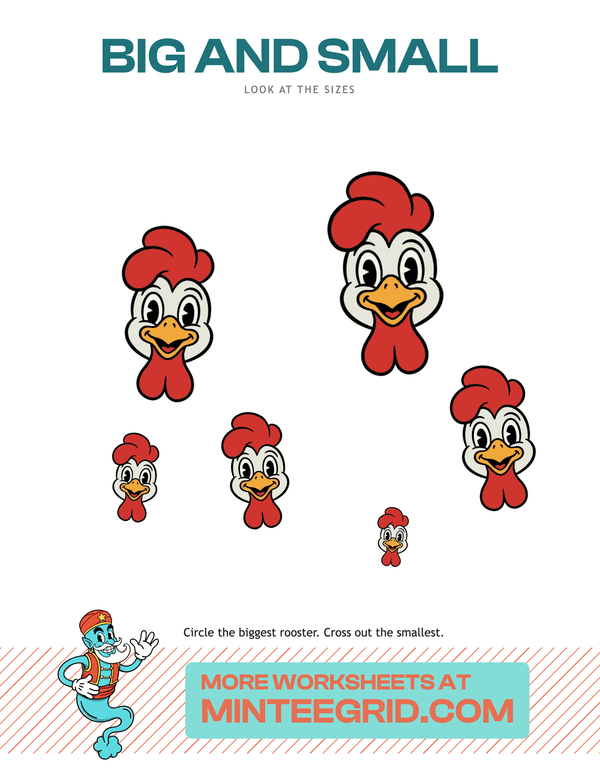
That is how our Big and Small sheets work: one picture — a duck, a fish, a rocket — scattered over the page in six to twelve sizes. Circle the biggest, cross out the smallest. On the hard level the sizes are close, so the top two need a careful look.
Try it yourself
Big and Small
One picture in many sizes: circle the biggest, cross out the smallest. Math · 3–6 years.
Putting sizes in order
Once biggest and smallest are easy, put a row in order. Small to Big asks a child to number shapes from smallest to biggest, or pencils from shortest to longest — the last step before measuring with units.
FAQ
When do children learn big and small?
Most toddlers understand big and small by two or three. Comparing several sizes and putting them in order comes around four to six, and measuring with units in first grade.
Why is comparing sizes important?
It is the start of measurement. The kindergarten standard K.MD.2 asks children to compare two objects and say which has more of an attribute — taller, longer, heavier — before any ruler appears.
What size words should preschoolers know?
Big and small first, then bigger and smaller, biggest and smallest, tall and short, long and short, heavy and light, full and empty.