Greater than, less than: the alligator and better tricks
October 12, 2026 · 6 min read
The rule that never breaks: the open side of the sign faces the bigger number. 9 > 4. 3 < 8. Everything else — alligators, Pac-Man, birds — is a picture to help a young child remember that one rule. Pictures are fine to start with. The trouble is what happens after.
Why the alligator stops working
The alligator "eats the bigger number." Kindergartners love it, and it works perfectly within 10. Then two things happen.
First, children start drawing the alligator instead of reading the sign. Ask them to read 3 < 8 out loud and you get "the alligator eats the eight" — which is true, but it isn't math. They have to translate back to "three is less than eight" every time, and on a test with forty problems, that translation is where errors creep in.
Second, the numbers get bigger, and "which is bigger" stops being obvious. 307 and 370 look almost the same. The alligator can't help with that. Place value can.
Lifehack: have your child read every comparison as a sentence, left to right, out loud — "fifty-two is greater than twenty-five." The sentence is what a teacher means, and saying it catches backwards signs instantly, because "two is greater than nine" sounds wrong.
The trick that works with any size number
Line the two numbers up by place value and go from the left:
- More digits wins. 1,204 is bigger than 987, whatever the digits are.
- Same number of digits? Compare the biggest place first. If it matches, move one place right.
- The first place where they differ decides. Nothing after it matters.
4,518 vs 4,581: thousands match (4 and 4), hundreds match (5 and 5), tens differ — 1 and 8. So 4,518 < 4,581. Done; the ones don't matter at all.
Lifehack: write the second number directly under the first, digits lined up, and circle the first column where they differ. It turns a "big number" problem back into a one-digit comparison.
The pairs that actually test the skill
A practice sheet where every pair is wildly different — 12 vs 87 — teaches very little. Children can eyeball those. The pairs that matter are:
- Same digits, different order: 52 and 25, 307 and 370, 4,518 and 4,581.
- Same leading digits: 63 and 68, 815 and 851.
- Equal pairs: about one in ten, so = is a real answer and not a trick.
That's how our comparing numbers sheets are built: most pairs are close on purpose, so the child has to look past the first digit.
Don't skip the equal sign
Many first graders believe = means "the answer comes next." Ask them whether 7 = 7 is true and they hesitate; show them 8 = 5 + 3 and they say it's backwards. That belief causes trouble for years, all the way into algebra.
The fix is comparing expressions, not just numbers: 7 + 5 ○ 13. The child has to work out one side, then compare. Now = means "the same amount as" — which is what it has always meant. The sums mode on the comparing sheet does exactly this, and it's worth a few sheets even after plain comparisons are easy.
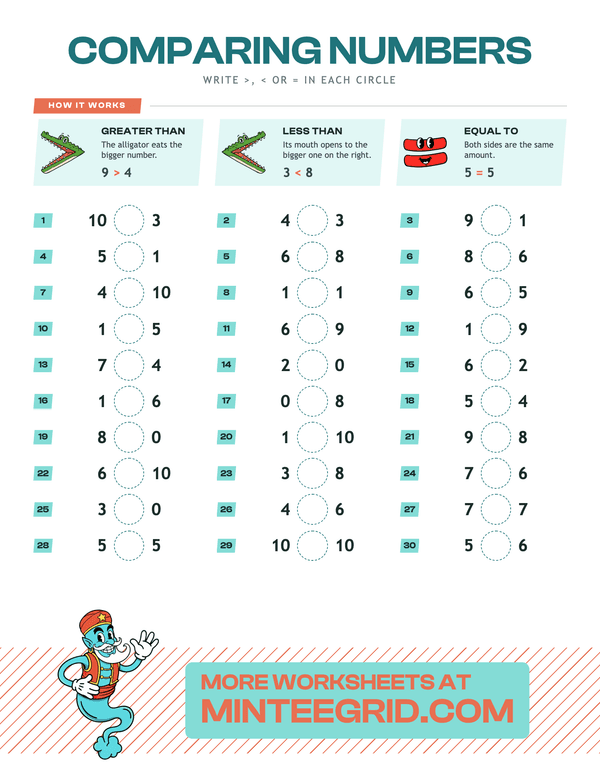
Try it yourself
Comparing Numbers
Write >, < or = between two numbers — from within 10 up to a million, most pairs close enough to make it matter. Math · 5–10 years.
A five-minute routine
- Monday to Wednesday: one short sheet at the current level, read every answer aloud.
- Thursday: the sums mode — compare expressions, not numbers.
- Friday: one row from the next level up. If it goes smoothly, that's next week's level.
For more on how place value works under all of this, see place value and the missing zero.
FAQ
How do you explain greater than and less than to a child?
Start with the rule that always works: the open side of the sign faces the bigger number, and the point aims at the smaller one. 9 > 4 reads 'nine is greater than four'; 3 < 8 reads 'three is less than eight'. The alligator that eats the bigger number is a fine first picture, but have the child read the sentence out loud every time so the meaning sticks, not just the mouth.
What grade learns greater than and less than?
Kindergarten compares numbers within 10 (K.CC.7). First grade uses the symbols >, < and = with two-digit numbers (1.NBT.3). Second grade compares three-digit numbers (2.NBT.4), and fourth grade compares multi-digit numbers up to a million (4.NBT.2).
How do you compare big numbers?
Line them up by place value and compare from the left: the number with more digits is bigger; if they have the same number of digits, the first place where the digits differ decides. 4,518 and 4,581 match in the thousands and hundreds, so compare tens: 1 < 8, so 4,518 < 4,581.
Why does my child get 52 and 25 wrong?
Because they're comparing the digits they see first, or comparing the ones. Pairs made of the same digits in a different order are exactly the ones that test place value, which is why good practice sheets include lots of them.