Place value and the missing zero: why 307 gets written as 37
October 12, 2026 · 7 min read
Place value is the idea that a digit is worth more or less depending on where it sits. The 3 in 352 isn't three — it's three hundred. Move it one place left and it's worth ten times more; one place right, ten times less. Everything in elementary arithmetic, from regrouping to long division, sits on top of this one idea.
The mistakes that show it's missing
- Writing 307 as 37. The child hears "three hundred seven," writes the 3 and the 7, and the zero — which nobody said — never makes it to the paper.
- Writing 307 as 3007. The opposite: "three hundred" becomes 300, then "seven" is tacked on the end.
- Thinking 52 and 25 are about the same. Same digits, so same size.
- Lining digits up from the left when adding stacked numbers, so the tens of one number land under the ones of the other.
Every one of these is the same misunderstanding: a digit is being treated as its face value, not its place value.
Trick 1: make the empty place visible
The zero in 307 is hard because it stands for nothing — no tens at all. Base ten blocks fix that by turning every place into a pile you can count: three flats, no rods, seven cubes. The empty space where the rods would be is something a child can actually see.
Lifehack: draw three columns labeled H, T and O on a sheet of paper. Have your child build the number in the columns with tally marks or dots. When the T column stays empty, ask "what do we write when there's nothing here?" — and the zero has a reason to exist.
Our base ten blocks sheets put numbers with a zero in the tens or ones place on the page on purpose — about a quarter of them — because that's where the skill gets tested.
Trick 2: money
Dollars, dimes and pennies are hundreds, tens and ones. Most children already know a dime is worth ten pennies. $3.07 is three dollars, no dimes, seven pennies — and children rarely forget the zero dimes when they're handed actual coins.
Trick 3: say it in places, not in words
Have your child read 352 as "3 hundreds, 5 tens, 2 ones" before reading it as "three hundred fifty-two." It feels slow. It also makes every digit's value explicit, and it's the bridge to expanded form: 300 + 50 + 2.
Trick 4: build the biggest number
Give your child three digit cards — 4, 0, 7 — and ask for the biggest number they can make (740) and the smallest (407, not 047). It's a puzzle, so it doesn't feel like practice, and it can only be solved with place value. Our digit cards sheets are built on exactly this.
Trick 5: the three forms
US second graders write numbers three ways: standard form (352), word form (three hundred fifty-two) and expanded form (300 + 50 + 2). Converting between them in all directions is the best all-round place value check there is — and expanded form is where the missing-zero mistake becomes impossible to hide. Practice them together with number forms sheets.
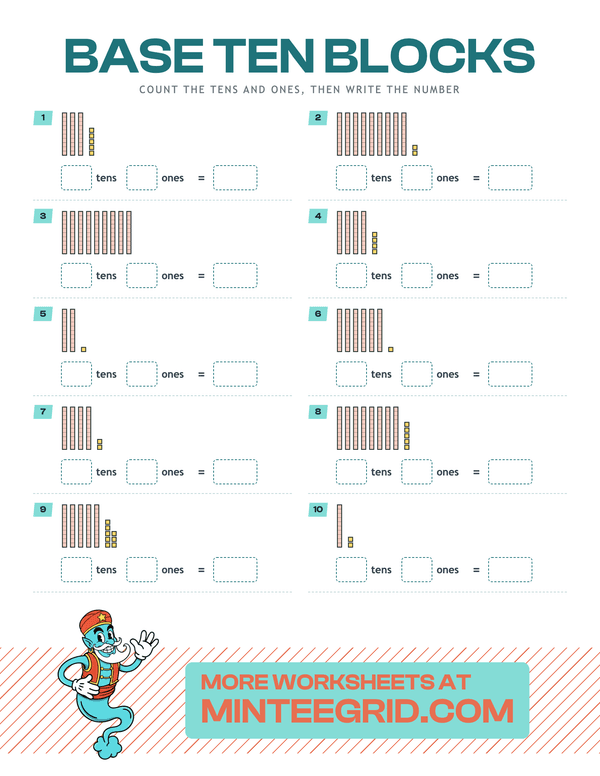
Try it yourself
Base Ten Blocks
Count the flats, rods and cubes and write the number — or draw a number with blocks yourself. Math · 6–8 years.
How to know it's solid
Ask: "In 4,518, what is the 5 worth?" A child who answers "500" without pausing has it. A child who says "5" or counts on fingers needs more time with blocks and charts. That one question is a better test than a page of problems.
Place value shows up again in regrouping and in comparing big numbers — both are much easier once this is in place.
FAQ
What is place value?
Place value is the idea that a digit's value depends on where it sits. In 352, the 3 means 3 hundreds (300), the 5 means 5 tens (50) and the 2 means 2 ones. The same digit is worth ten times more for every place it moves left.
Why does my child write 307 as 37?
Because they hear 'three hundred' and 'seven' and write the digits they hear. The zero isn't said, so it isn't written. They need to see that the tens place still exists when it's empty — base ten blocks or a place value chart make the empty place visible.
What grade learns place value?
First grade learns that two-digit numbers are tens and ones (1.NBT.2). Second grade extends this to hundreds and to reading and writing numbers to 1,000 in standard, word and expanded form (2.NBT.1, 2.NBT.3). Fourth grade generalizes it to multi-digit numbers (4.NBT.1).
What is expanded form?
Writing a number as the sum of its place values: 352 = 300 + 50 + 2. It's the most direct way to check that a child knows what each digit is worth.