I Spy worksheets are secretly a counting drill — here's why that's the point
July 14, 2026 · 6 min read
The name suggests something is hidden. On a MinteeGrid I Spy sheet, nothing is — every object sits in plain sight from the first glance. What the sheet is actually testing is whether a child can tell two similar-looking things apart at a glance, and count how many of one specific kind are scattered through a busy scene. That's a real, useful, different skill from "find the hidden thing," and naming it accurately changes how to use the sheet well.
What's actually being practiced
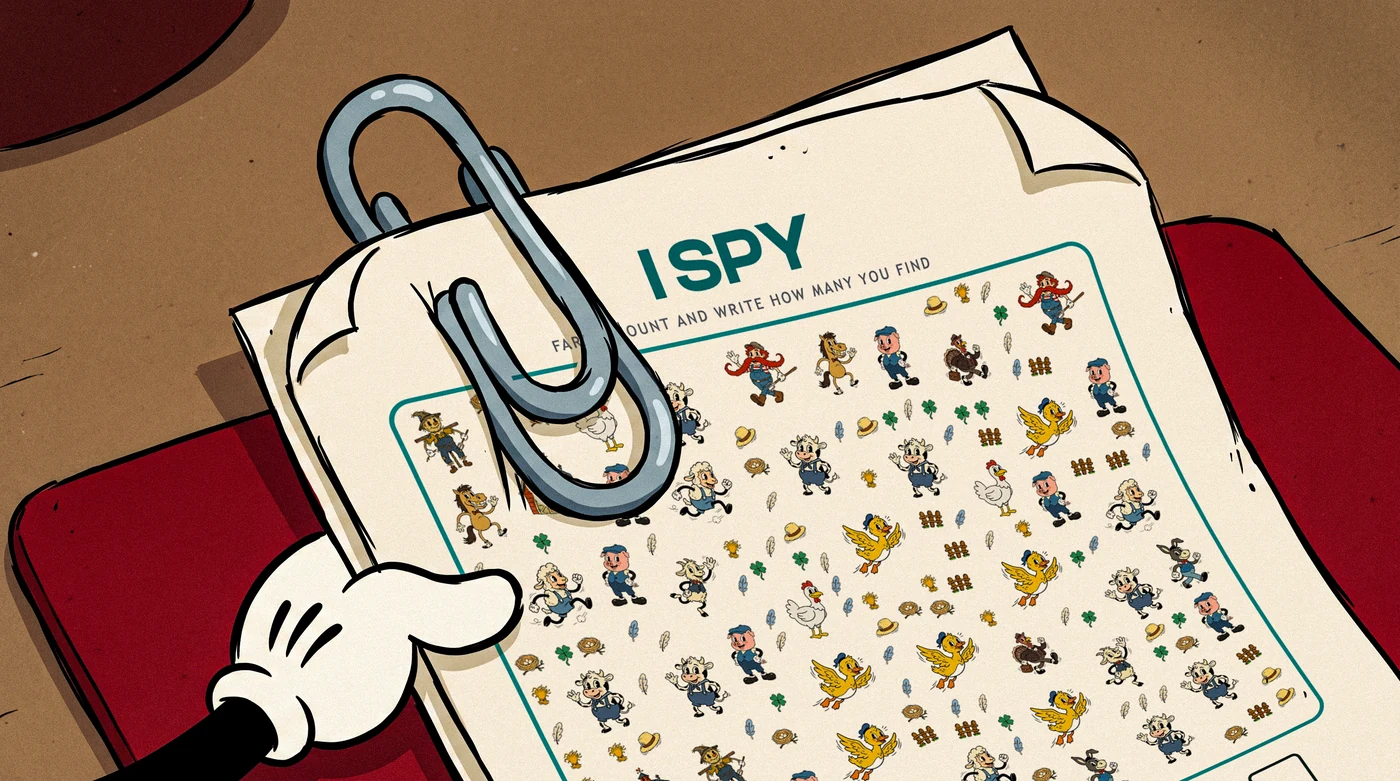
Two skills, stacked:
- Visual discrimination — picking one object out of a scene full of similar-looking shapes, colors, and sizes. This is the same skill behind letter recognition (b vs. d) and early reading, well before it's ever framed that way.
- One-to-one counting — pointing at (or mentally tracking) each matching object exactly once, not twice, not zero times, and landing on the right total.
Neither skill is "find the object" — the object was never lost. The task is closer to a scavenger hunt where everything's already on the table and the job is sorting and tallying, not searching.
Why "count all the X" beats plain "find the X"
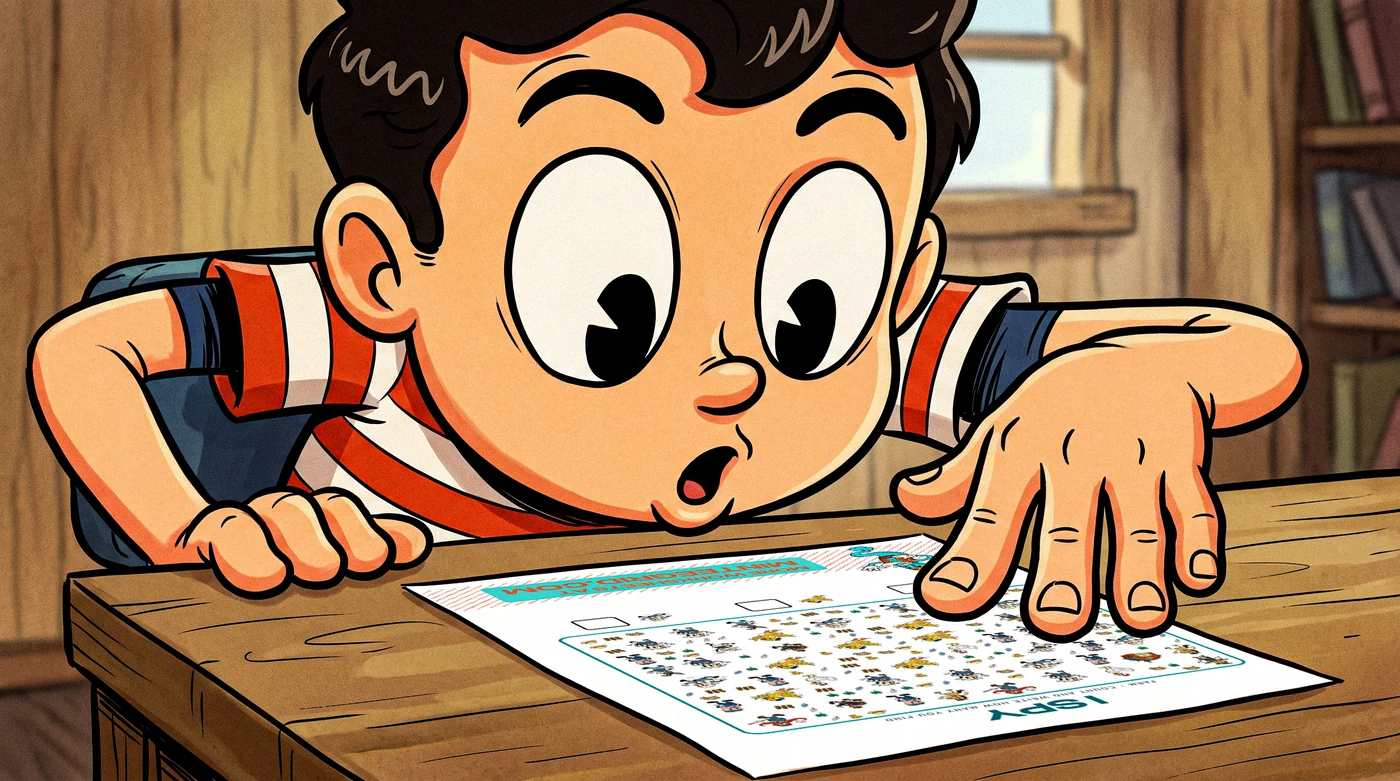
A worksheet that just asks "can you spot the crab?" is solved the instant the eye lands on one crab — after that, there's nothing left to do. Asking "how many crabs are there?" keeps the task alive across the whole scene: a kid has to keep scanning past the crab they already found, track what's already been counted, and resist stopping early. That's a meaningfully harder and more useful task built from the exact same artwork.
The difficulty knob reflects this directly — it isn't a vague "easy/medium/hard" label, it's a specific, measurable thing: the physical size each target object is drawn at.
- Easy — larger target artwork, easier to visually separate from the smaller background filler.
- Medium — a middle size, closer to the filler's own size.
- Hard — smaller target artwork, closer in size to the filler, which makes the eye work harder to tell "this is one to count" from "this is just scenery."
The filler objects themselves are always small and uniform on purpose — they're meant to read as background texture, never as something a kid might mistake for a thing to count.
Lifehack: for a first sheet with a new kid, start with only 2–3 target types instead of the max — fewer categories to hold in mind at once means the counting itself gets tested cleanly, without the sheet also testing working memory for "wait, which ones am I even looking for."
The four themes, and when to use which
All four themes use the same difficulty mechanics — the choice between them is really about what's motivating on a given day, not a difficulty decision:
- Farm — animals plus a farmer, barn, and scarecrow (not animals-only, on purpose — a farm scene has more than livestock in it). Good mix of object shapes for discrimination practice.
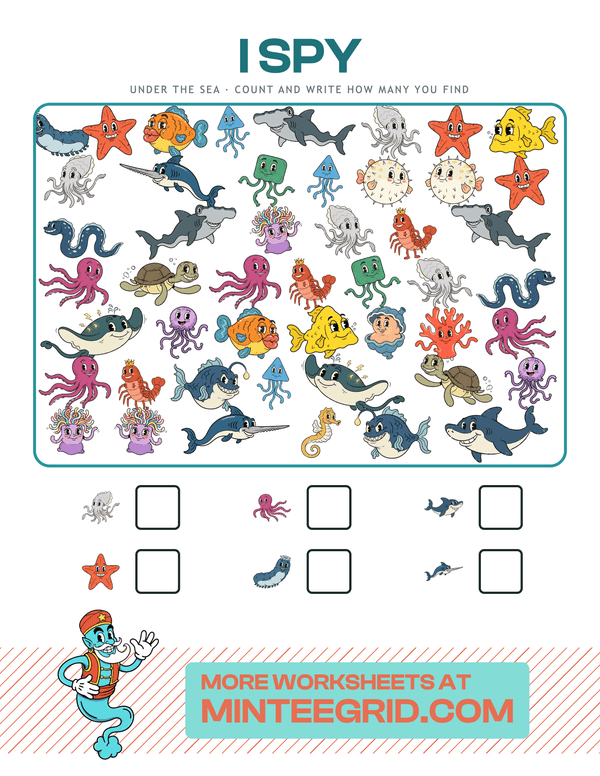
- Under the Sea — fish, crabs, and other sea life; consistently the easiest theme to visually sort by shape.
- Outer Space — rockets, planets, stars; strong pick for a kid who's currently obsessed with space, which does more for engagement than the mechanics do.
- Vegetable Garden — a slightly denser, more textured scene; a reasonable one to save for once a kid is comfortable with the mechanic on an easier theme first.
How this fits into a difficulty routine
The general difficulty-picking approach — watch the first reaction, aim for effortful-but-solvable — applies here the same as anywhere else, with one I Spy–specific tell: watch whether the child re-scans the whole picture before answering, or just guesses a number. A confident re-scan followed by a right or slightly-off count means the difficulty is in the right zone. An instant guess with no visual search at all usually means the sheet's too easy to require actually looking.
Try it yourself
I Spy
I-spy scenes with themed objects to find and count. Focus · 3–5 years.
Not the same thing as a hidden picture book
The market is full of hidden-picture and "I spy" books and printables, and it's worth being direct about what's actually different here: a printed book has a fixed scene, so the second time through, a kid isn't counting — they're remembering where things were last time. A generated I Spy sheet is scattered fresh on every request, at the theme and difficulty picked, so there's no fixed layout to memorize and no way to shortcut the count. Same underlying idea, a materially different (and more repeatable) practice tool.
FAQ
What age are I Spy worksheets good for?
Roughly 3–5, the range where counting and telling similar-looking objects apart are both still being built. A kid who's already fluent at both will find even the hardest scene too easy in a few sittings; that's the cue to move on to a generator that targets a different skill.
Is this the same as a hidden picture puzzle?
Mechanically no, even though people search for both with similar words. A hidden picture puzzle asks "can you find it at all" — the challenge is spotting something camouflaged. An I Spy worksheet asks "how many are there" — everything is visible from the start, and the task is counting and telling look-alikes apart, not searching.
Why does the same theme produce a different sheet every time?
Because nothing on it is pre-made — object positions, filler mix, and target counts are all generated fresh per request. A static hidden-picture PDF can only ever be solved once before the positions are memorized; a freshly generated scene can be practiced again without that shortcut.
My kid keeps miscounting by one. Is the difficulty wrong?
Not necessarily — off-by-one is usually a scanning issue (double-counting one object or skipping one at the edge of the scene), not a counting-ability issue. Try easy difficulty for a few sheets to confirm the count itself is solid, then move back up; if the same one-off pattern persists at easy too, that's worth a closer look with a teacher.