More or fewer: comparing groups before comparing numbers
October 20, 2026 · 5 min read
Long before a child writes 7 < 9, they need to know that a pile of 7 has fewer than a pile of 9 — and why. Comparing groups is that first step, and it is where "more" and "fewer" start to mean something.
Two ways children compare
Matching. Line the two groups up, one beside the other. The group with some left over has more. This works before a child can count far, and it is the idea behind subtraction: the leftovers are "how many more."
Counting. Count each group and compare the numbers. Faster, but only works once counting is solid.
Kindergartners are expected to do both (K.CC.6), with groups up to ten.
Lifehack: set the table "wrong" — four plates and three cups. Ask if there are enough cups. Matching plates to cups shows the missing one at a glance.
The trap: big things look like more
Young children often think a spread-out row has more than a bunched-up row with the same number. It is a famous finding about how children think, and it fades with counting practice. Mixing sizes on purpose helps: three big balloons are fewer than five small ones.
On paper
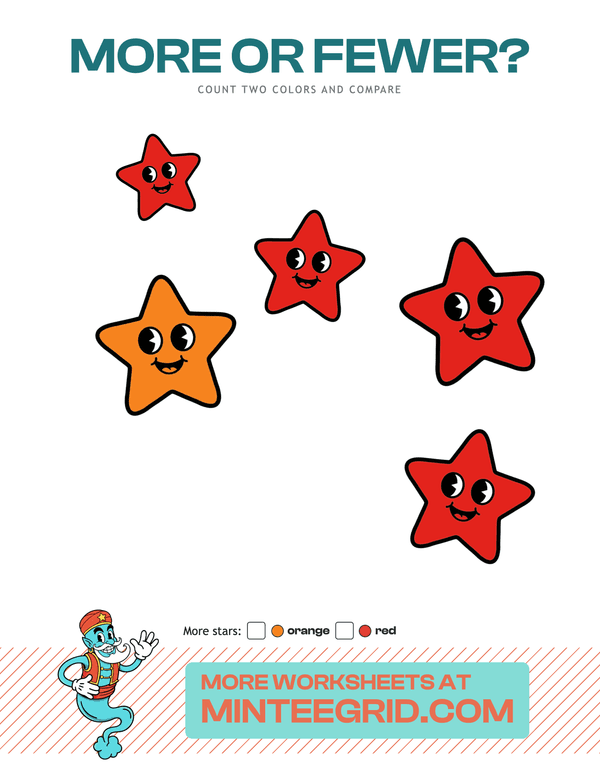
Our More or Fewer? sheets scatter one picture in two colors over the page, in different-sized groups and different sizes so bigness is not a clue. Tick the color with more; from the middle level, also write how many more. The hard level adds a third color to ignore.
Try it yourself
More or Fewer?
Two colors of one picture: which has more, and how many more? Math · 4–7 years.
From groups to numbers
Once groups are easy, move to numbers: Comparing Numbers uses >, < and =, and our post on greater than and less than tricks explains why the alligator works — and when it stops working.
FAQ
When do kids learn more and fewer?
In kindergarten. The standard K.CC.6 asks children to say whether one group has more, fewer or the same as another, by matching or counting, for groups of up to ten.
What is the difference between fewer and less?
Fewer is for things you count (fewer apples), less for amounts you do not (less water). Teachers use both; kindergarten sheets usually say more or fewer.
How do I teach comparing groups?
Start by lining the two groups up one to one: the group with extra left over has more. Then count both groups and compare the numbers.