Why daily routines help kids — and how to make one they will follow
October 20, 2026 · 6 min read
Most arguments with young children happen at the joins of the day: getting dressed, leaving the house, turning off the TV, going to bed. A routine does not remove those joins, but it makes them predictable — and a child who knows what comes next has far less reason to fight it.
Why routines work
- Less worry. Not knowing what comes next is stressful for children. A routine answers the question before it is asked.
- Fewer battles. "It's bath time because it's 7:00" is a fact of the day, not your decision to argue with.
- Better sleep. A steady bedtime routine is one of the most reliable ways to help a child fall asleep.
- Independence. A child who knows the order of the morning can do more of it alone.
How to build one together
- Write down the day as it already happens. Most families have a routine; it just is not written.
- Keep it to five or six steps. Wake up, breakfast, school, play, dinner, bed.
- Make it visual. Pictures for the youngest, words and times for readers.
- Let your child help. A chart they drew gets followed.
- Put a clock on it. Times turn the chart into something to check, not just to follow.
Lifehack: when a step is done, let your child move a clothespin down the chart. It is a small thing that makes the routine theirs.
The clock makes it math
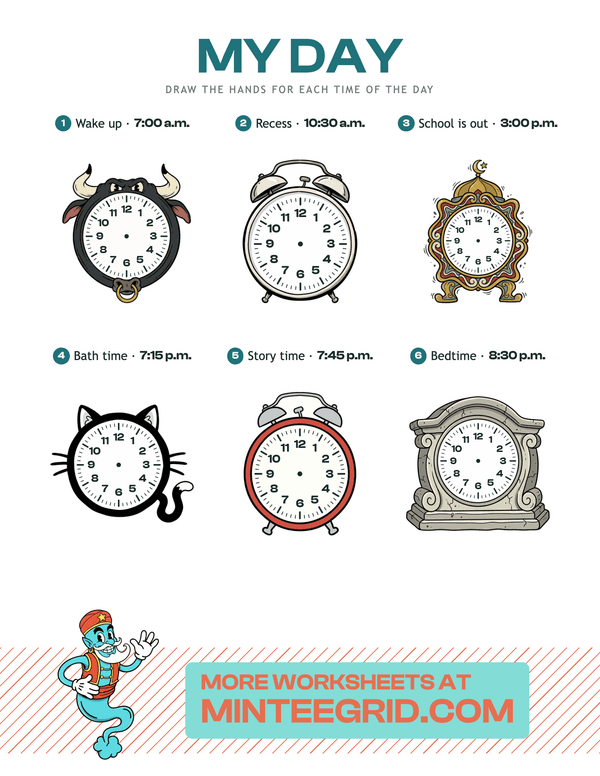
Once a routine has times, it is a telling-time lesson your child actually cares about: "Dinner is at 6:00. Where will the hands be?" Our My Day sheet is a day in six clocks — wake up, recess, lunch, homework, story time, bedtime — with a.m. and p.m., to draw the hands or write the time.
Try it yourself
My Day
A day in six clocks, from wake up to bedtime: draw the hands or write the time. Math · 5–8 years.
When the routine breaks
Holidays, travel and sick days break routines, and that is fine. Name the change ahead of time — "Tomorrow is different: no school, we're going to Grandma's" — and go back to the usual day as soon as you can. A routine that bends is better than one that snaps.
For more on big feelings at the joins of the day, see calm-down strategies that actually work.
FAQ
Why are routines important for children?
A predictable day lets children know what is coming, which lowers anxiety and the number of battles over transitions. Routines around sleep and meals are linked with better sleep and behavior in young children.
How do I make a routine my child will follow?
Keep it short, make it visual, and build it together. A chart with pictures and times, which the child helped make, gets followed far more than a list of rules.
What should be in a daily routine for kids?
Wake up, meals, school or play, some quiet time, a bit of outside time, a bedtime routine and a set bedtime. Leave room for free play — a routine is a frame, not a schedule for every minute.