Classroom games that make telling time stick
October 20, 2026 · 6 min read
Telling time is a skill that fades without use and grows with daily practice. A game a day does more than a worksheet a week — and children ask to play it.
1. Clock Bingo
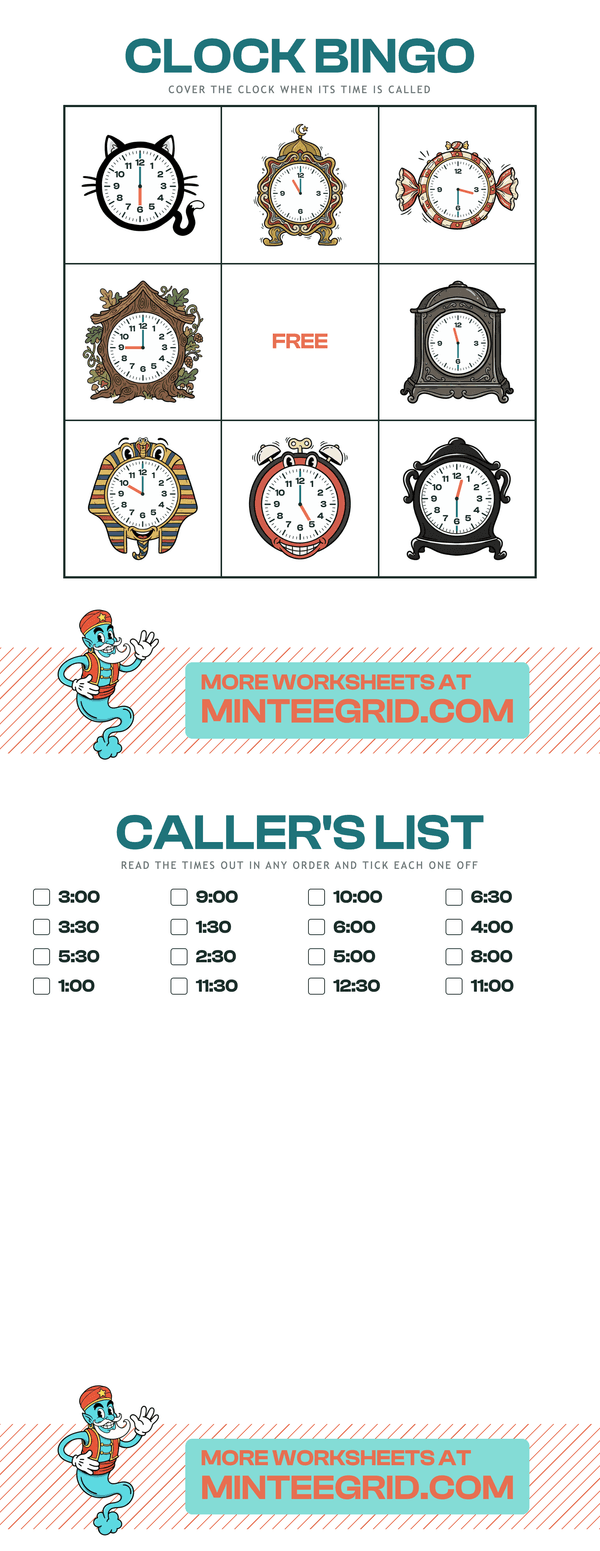
Every child gets a different card of analog clocks; you read out digital times; they cover the matching clock. It is reading a clock dozens of times without anyone calling it practice.
Our Clock Bingo prints a class set of different 3x3 or 4x4 cards from one pool of times, with the caller's list last — on the hour and half hour for first grade, five minutes for second.
Try it yourself
Clock Bingo
A class set of different bingo cards of clocks, plus the caller's list of times. Math · 6–9 years.
2. Human clock
Twelve children stand in a circle holding numbers. A tall child is the minute hand, a short one the hour hand. Call a time; the hands walk to it. Everyone checks.
3. I have, who has
Cards in a chain: "I have 3:30. Who has half past four?" The whole class has to listen to every card.
4. Around-the-room hunt
Tape clocks around the room. Children walk with a clipboard and write each time. Movement plus reading — good for after lunch.
5. Beat the clock
"Clean up before the long hand reaches the 4." Real deadlines make the minute hand matter.
6. Time of the day
At random moments: "What time is it right now?" The first to read the wall clock right picks the next song.
7. Clock match
Pairs of cards — analog and digital — face down. Memory game rules. Or use our Telling Time match sheet.
8. Who's late?
Give each group a schedule and a clock. Who is late for what? Our Who's Late? sheet is that game on paper.
Lifehack: keep a big clock with movable hands by the door. Let one child set it to the next activity's time before each change. The class reads it without being asked.
For how to teach the skill itself, see how to teach telling time, one hand at a time.
FAQ
How can I make telling time fun?
Turn it into a game: clock bingo, around-the-room hunts, human clocks on the playground, I have, who has. Short, daily and active beats a long worksheet session.
What is a human clock?
Children stand in a circle as the numbers, and two children — one tall, one short — are the hands. The class calls a time and the hands move to show it.
How do you play clock bingo?
Each child has a different card of clocks. The teacher reads times aloud; children cover the clock showing that time. The first full row wins.