Regrouping without tears: carrying and borrowing, explained
October 12, 2026 · 7 min read
Regrouping is trading between place values: ten ones for one ten when adding, one ten for ten ones when subtracting. That's the whole idea. It used to be called carrying and borrowing, and the old names are part of why it confuses children — nothing is carried anywhere and nothing is ever given back. A ten simply changes form.
Most children who struggle with it don't struggle with the idea. They struggle with three specific, predictable mistakes. Each one has a small fix.
What does regrouping actually look like?
Take 47 + 25. The ones are 7 + 5 = 12. Twelve ones is too many for the ones place, so trade ten of them for a ten: write the 2, put a small 1 over the tens. Then 4 tens + 2 tens + that 1 traded ten = 7 tens. Answer: 72.
Now 52 − 18. You need to take 8 ones from 2 ones, and you can't. So break one of the five tens into ten ones: the 5 becomes 4, the 2 becomes 12. Now 12 − 8 = 4 and 4 − 1 = 3. Answer: 34.
Lifehack: say "trade" instead of "carry" or "borrow" from day one. "We don't have enough ones, so we trade a ten for ten ones" describes exactly what happens on the page — and a child who understands trading can check their own work.
Mistake 1: subtracting the smaller digit from the bigger one
The most common regrouping error in second grade: 52 − 18 = 46. The child looked at the ones column, saw an 8 and a 2, and did 8 − 2. It isn't carelessness — in every single-digit fact they've done so far, the bigger number came first.
The fix: one rule, said out loud at every column before any math happens: top number first. Is the top big enough? If not, trade. It feels slow for a week. Then it becomes the habit, and the error disappears.
Mistake 2: forgetting the traded ten
The child does the trade in their head, writes the 2 in 47 + 25 = ?2, then adds 4 + 2 in the tens and writes 62. The traded ten vanished.
The fix: always write it down, small, above the next column — even when they "know" it. A worksheet with room for that small digit helps; so does a crossed-out digit in subtraction (the 5 struck through, a 4 written above). The answer key on our regrouping sheets shows every one of those marks, so a parent can see exactly where a wrong answer went wrong.
Mistake 3: zeros in the top number
405 − 128. There are no tens to trade from. Children either freeze or write something creative. This is the hardest case in the whole topic, and it deserves its own practice.
The fix: trade from the hundreds first. 405 is 4 hundreds, 0 tens, 5 ones — trade one hundred for ten tens (3 hundreds, 10 tens), then one ten for ten ones (9 tens, 15 ones). Now subtract column by column. Doing it with base ten blocks once or twice — physically or on paper — makes the double trade obvious in a way no explanation can.
Lifehack: before starting a problem with a zero in the top number, have your child rewrite the top number "ready to subtract" in the margin — 405 becomes 3 hundreds, 9 tens, 15 ones. Two lines of extra work that remove nearly every mistake.
How should a child practice regrouping?
Mix problems that need regrouping with problems that don't. A sheet where every problem needs a trade teaches the child to always trade — which produces its own mistake (trading when the top digit is already bigger). The real skill is deciding, column by column, whether a trade is needed.
A good progression:
- Two digits, regrouping in the ones only — 38 + 24, 52 − 17.
- Three digits, regrouping in one column — the trade can happen in the ones or the tens.
- Three digits, regrouping in two columns — 467 + 285.
- Zeros in the top number — 400 − 163, the double trade.
Graph paper helps more than you'd expect: one digit to a square keeps the columns lined up, and a misaligned column is the silent cause of many "regrouping" errors that aren't regrouping errors at all.
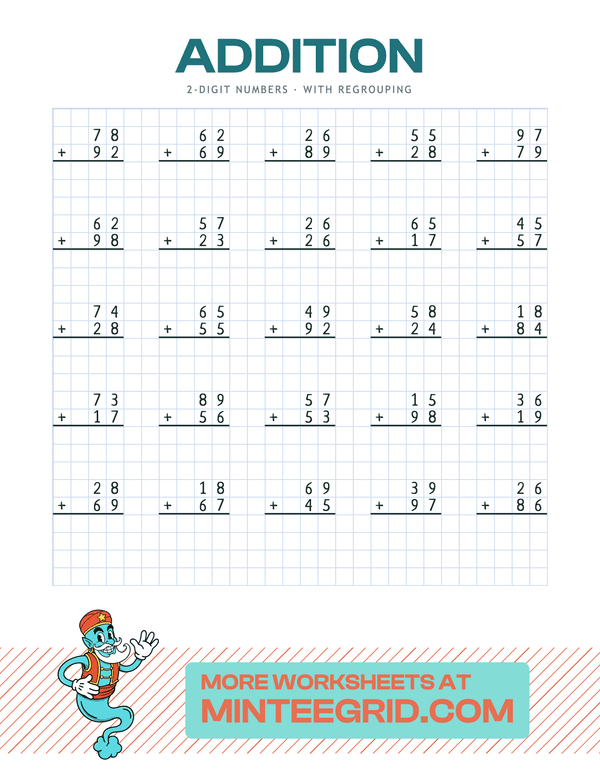
Try it yourself
+ and − Regrouping
Stacked on quarter-inch graph paper, with or without regrouping — every carry and borrow in the key. Math · 7–10 years.
When is regrouping "done"?
When your child can explain why they trade, not just when. Ask: "Where did that little 1 come from?" A child who says "it's the ten from the twelve" understands it. A child who says "you always put a 1 there" is following a recipe that will break on the first zero.
For the place value underneath all of this, see place value tricks for the number that turns into 37.
FAQ
What is regrouping in math?
Regrouping is trading between place values: ten ones become one ten, or one ten becomes ten ones. In addition it is what used to be called carrying (7 + 5 ones makes 12 ones, which is 1 ten and 2 ones). In subtraction it is what used to be called borrowing (to take 8 ones from 3 ones, break a ten into ten ones first).
What grade learns addition and subtraction with regrouping?
Second grade, in the US Common Core standards: adding and subtracting within 1,000 using place value (2.NBT.7). Fourth grade expects the standard algorithm fluently with multi-digit numbers (4.NBT.4). Many children meet two-digit regrouping at the end of first grade.
Is carrying the same as regrouping?
Yes. Carrying and borrowing are the older names. Regrouping is the word US schools use now because it says what actually happens — the number is not borrowed and given back, it is regrouped into different place values.
Why does my child subtract the smaller digit from the bigger one?
Because in a single-digit fact the bigger number always comes first, and the habit carries over: in 52 − 18 they see 8 and 2 and write 6. The fix is a rule said out loud before every column: top number first. If the top is smaller, regroup.