How to teach kids to name their feelings
October 13, 2026 · 6 min read
Children feel big feelings long before they have words for them. A three-year-old who is furious that the tower fell over has two options: show it, usually loudly, or say it. Saying it is only possible if they have the word. Teaching feelings words is one of the most practical parts of what US schools now call social-emotional learning — and most of it happens at home, in small moments, without a lesson plan.
Start with the feelings you can see
The first feelings to name are the ones that show plainly on a face:
- Happy — a smile, bright eyes.
- Sad — a frown, tears, a quiet voice.
- Angry — a scrunched face, tight fists.
- Scared — wide eyes, holding on to you.
Then add surprised and tired, and later the ones children feel every day but rarely have words for: frustrated, worried, proud, excited, disappointed, embarrassed. A child who can tell "angry" from "frustrated" can tell you what kind of help they need.
Lifehack: be the narrator. When you see a feeling, name it in one short sentence, without fixing anything yet: "You're frustrated — the puzzle piece won't fit." It takes three seconds, and it's how most feelings vocabulary is learned.
Name your own feelings, too
Children learn feelings words the way they learn every other word: by hearing them used. Say yours out loud, with the reason: "I'm feeling impatient because we're late. I'm going to take a big breath." You're teaching the word, and showing that grown-ups have feelings and do something about them.
Make faces together
Feelings live on faces, and children learn to read them by making them.
Lifehack: play the mirror game. Stand at a mirror and take turns: "Show me surprised! Now show me worried." Then ask how they knew what each face was — the eyebrows, the mouth. It's silly, and it teaches exactly what to look for on other people's faces.
Lifehack: when reading a picture book, pause on a character's face and ask "How do you think she feels? How can you tell?" Books are full of feelings, and the pictures do half the teaching.
Drawing feelings
Drawing a feeling is recognizing it in reverse: to draw "surprised," a child has to picture round eyes and an open mouth. That's why feelings drawing pages are a staple of US preschool and kindergarten classrooms.
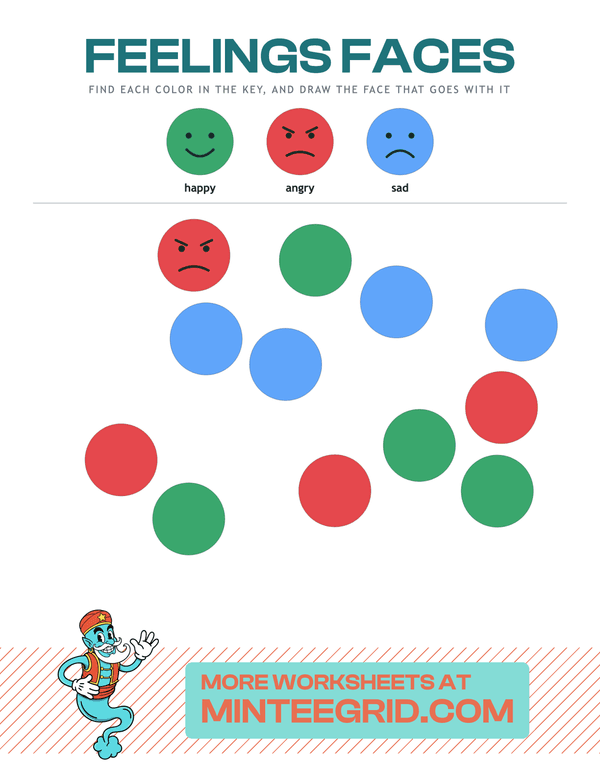
Our Feelings Faces sheets work that way: a key of colored faces — green is happy, blue is sad, pink is surprised — and a page of blank colored circles to draw the right face on. The harder level puts sad and worried side by side, two feelings that look a lot alike.
Try it yourself
Feelings Faces
Each color is a feeling: draw the happy, sad or surprised face on every colored circle. Focus · 3–6 years.
A daily feelings check-in
A check-in is a simple routine many classrooms use: once a day, everyone says how they feel.
- Pick a time — breakfast, the car ride home, bedtime.
- Ask one question: "What feeling was biggest today?"
- Ask one follow-up: "What made you feel that way?"
- Share yours, too. It shows them it's normal and safe.
Lifehack: draw four faces on a sticky note on the fridge — happy, sad, angry, worried — and let your child point to one when words are hard. Pointing counts. The words come later.
What not to do
- Don't rush to fix it. "You're sad your friend left" first; solutions after.
- Don't argue with the feeling. "You're not really mad" teaches a child that their feelings are wrong, not how to handle them.
- Don't save feelings talk for bad moments. Name happy, proud and excited just as often, or "let's talk about feelings" starts to mean "you're in trouble."
For what to do when a feeling is already too big, see calm-down strategies that actually work for kids. For the bigger picture, see social-emotional learning at home.
FAQ
At what age can children name their feelings?
Most two-year-olds can use a few feeling words like happy, sad and mad. By four or five, many children can name a dozen or more — scared, excited, frustrated, proud — and start to say why they feel that way. The range is wide, and vocabulary grows fastest when adults name feelings out loud in everyday moments.
What feelings should preschoolers learn first?
Start with four that are easy to see on a face: happy, sad, angry and scared. Then add surprised and tired, and later the in-between feelings children meet every day — frustrated, worried, proud, disappointed, excited.
Why does naming feelings help children calm down?
Putting a feeling into words gives a child something to do with it other than act it out, and it lets the adult respond to the real problem. Many educators use the phrase "name it to tame it," from psychiatrist Dan Siegel, for this idea.
Are feelings worksheets useful for preschoolers?
As one small part of it, yes. Drawing a face for a feeling asks a child to picture what that feeling looks like, which is the same skill as recognizing it on someone else. They work best alongside talking about feelings in real moments, not instead of it.