Social-emotional learning at home: a parent's guide
October 13, 2026 · 7 min read
Social-emotional learning — SEL, as US schools call it — is teaching children to understand their feelings, handle them, and get along with other people. It sounds like a school subject, but most of it is learned at home, in ordinary moments: a lost game, a shared toy, a hard morning. Here's what it covers and how to build it without turning family life into a lesson.
The five skills behind SEL
Many US schools use a framework from CASEL, a nonprofit that researches social-emotional learning. It groups the skills into five areas:
| Skill | What it looks like in a young child |
|---|---|
| Self-awareness | "I'm frustrated because I can't do the zipper." |
| Self-management | Taking a breath instead of throwing the toy. |
| Social awareness | Noticing a friend looks sad. |
| Relationship skills | Taking turns, sharing, saying sorry. |
| Responsible decision-making | Thinking about what will happen before doing it. |
You don't need to teach these in order, or by name. Every family already works on all five. The goal is just to do it a little more on purpose.
Daily habits that build SEL
Name feelings out loud. Yours and theirs. "You're disappointed the park is closed." A child who has the words can use them instead of acting out the feeling. More on this in teaching kids to name their feelings.
Practice calming down when things are calm. Breathing, counting, a calm corner — practiced as games on good days, so they're there on bad ones. See calm-down strategies that actually work.
Ask "how do you think they feel?" About characters in books, kids at the playground, people on TV. It's empathy practice, and it costs nothing.
Let them make small choices. Which shirt, which book, which sheet first. Then let them live with small results. That's decision-making practice at the right size.
Lifehack: at dinner, play "rose and thorn": everyone shares one good thing (a rose) and one hard thing (a thorn) from their day. It's a daily feelings check-in disguised as a game, and kids usually love hearing the adults' thorns.
Games that teach SEL without saying so
- Turn-taking games teach waiting, fair play and losing gracefully — skills children learn far better by losing a game than by hearing about them. Our Two Player Maze is built for two kids at once: two starts, one goal, and both routes the same length, so it's a fair race.
- Feelings charades: act out a feeling, others guess. Silly, and it teaches reading faces and bodies.
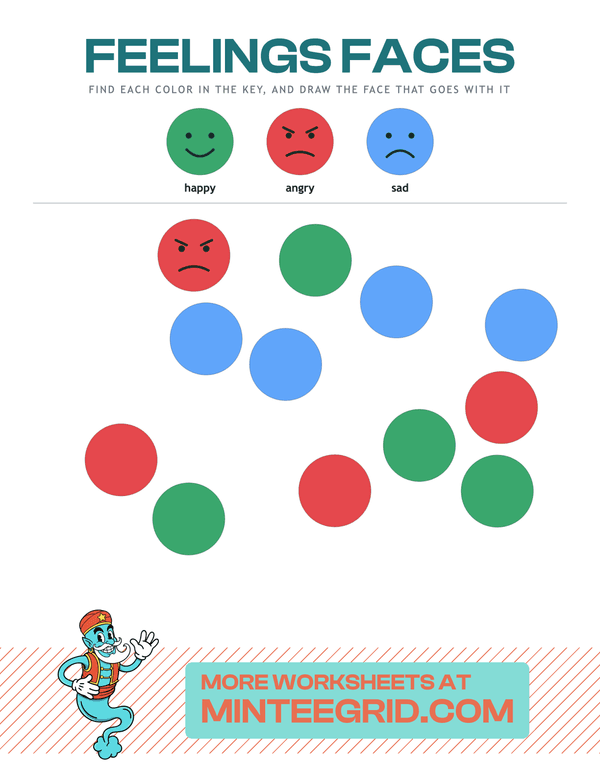
- Drawing feelings: drawing a face for "surprised" or "worried" means picturing what it looks like — the same skill as recognizing it on someone else. Feelings Faces turns that into a color-code page for preschool and kindergarten.
- Cooperative puzzles: working on one puzzle together, taking turns placing pieces.
Try it yourself
Feelings Faces
Each color is a feeling: draw the happy, sad or surprised face on every colored circle. Focus · 3–6 years.
Lifehack: when a game ends in tears over losing, don't skip games — play more of them, and lose cheerfully yourself, out loud: "Oh, I lost! That's disappointing. Good game — want to play again?" Children learn how to lose from watching how adults do it.
When to worry less
Meltdowns, tears over small things and squabbles over toys are normal at every stage of childhood. Social-emotional skills grow slowly, unevenly, with lots of steps backward on tired days. What matters is the general direction: more words for feelings, a little more waiting, a little more noticing others, month by month.
When to ask for help
If big feelings seem to be getting in the way of daily life — making friends, sleeping, going to school — most of the time, or if you're worried, talk to your child's pediatrician or teacher. They see many children, and can help you tell an ordinary rough patch from something that needs more support.
FAQ
What is social-emotional learning (SEL)?
Social-emotional learning is the process of building the skills to understand and manage emotions, set goals, feel empathy, build relationships and make responsible decisions. Many US schools follow the CASEL framework, which groups these into five areas: self-awareness, self-management, social awareness, relationship skills and responsible decision-making.
How can I teach social-emotional skills at home?
Mostly through everyday moments: naming feelings out loud, practicing calm-down strategies when things are calm, playing turn-taking games, talking about how characters in books feel, and letting children make small choices and live with the results.
At what age should social-emotional learning start?
From the very beginning, in simple ways. Toddlers start learning feeling words and turn-taking; preschoolers learn to name feelings and use simple calm-down strategies; school-age children work on empathy, solving conflicts and making decisions.
Are there games that teach social-emotional skills?
Yes. Turn-taking board games and two-player games teach waiting, fair play and losing gracefully. Feelings charades and drawing faces build emotion vocabulary. Cooperative puzzles teach working together.