Visual discrimination: the looking skill behind reading
October 20, 2026 · 6 min read
Before a child can read, they have to see that b and d are different — the same circle and line, facing opposite ways. Before they can write numbers, they have to notice that 6 and 9 are one shape turned over. That noticing has a name: visual discrimination.
What it is
Visual discrimination is the ability to see how things are alike and how they are different: shape, size, color, which way something faces, a missing detail. Children build it through play long before school, and it quietly underpins reading, writing and math.
Why it matters
- Letters differ by tiny details: b, d, p and q are one shape turned four ways.
- Words differ by a letter: was and saw, on and no.
- Numbers do the same: 6 and 9, 12 and 21.
- Math pictures — graphs, shapes, patterns — all depend on noticing what is the same.
A child who struggles with these is often not struggling with reading itself, but with seeing small differences fast enough.
Games that build it
Lifehack: play "what's changed?" Put five objects on a tray, let your child look, then hide them and move or swap one. They have to spot the change. Start with big changes and make them smaller.
- Matching pairs — memory cards, socks from the laundry.
- Spot the difference pictures.
- Sorting by shape, color or size.
- Copying a simple drawing or block tower.
On paper
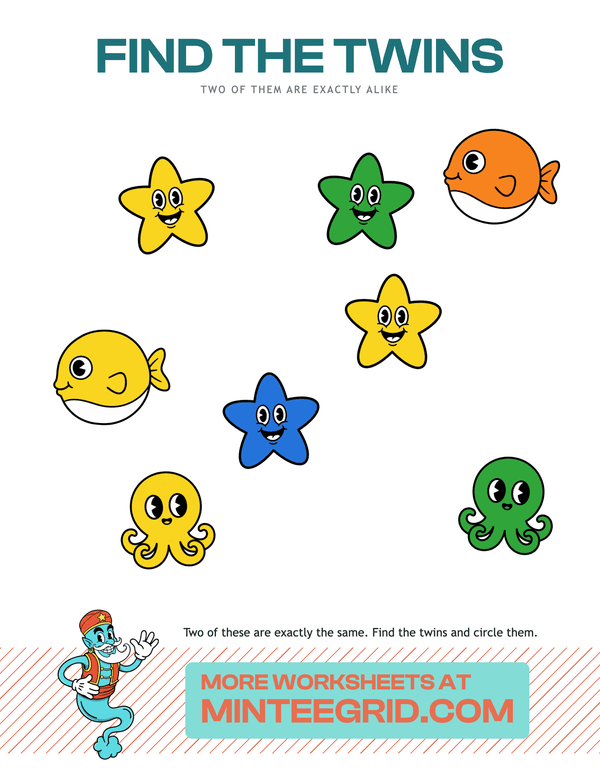
Two of our sheets are pure visual discrimination. In Find the Twins, a crowd of sea creatures in many colors hides exactly one matching pair: the eye has to check both the kind and the color of each one. In Spot the Odd One, a page of one picture has one that is turned, flipped or recolored.
Try it yourself
Find the Twins
Lobsters, seahorses and fish in many colors — exactly two are the same. Find the twins. Focus · 4–8 years.
Also good: Odd One Out, Square Code and Copy the Dots, which asks a child to see a pattern and reproduce it.
FAQ
What is visual discrimination?
The ability to notice how things are alike and different — shape, size, color, direction, small details. It is how a child tells a b from a d, or a 6 from a 9.
Why is visual discrimination important for reading?
Letters differ by small details: a b and a d are the same shape facing different ways, an n and an h differ by one line. Children who notice small differences learn letters more easily.
How can I improve my child's visual discrimination?
Spot-the-difference pictures, matching games, odd-one-out puzzles, sorting by color and shape, and drawing what they see. A few minutes a day is plenty.