Fact families: why they make subtraction half the work
October 12, 2026 · 6 min read
A fact family is three numbers and the four facts they make. 3, 5 and 8 give you 3 + 5 = 8, 5 + 3 = 8, 8 − 5 = 3 and 8 − 3 = 5. The point isn't the four facts. The point is that the last two aren't new: subtraction is addition read backward. A child who sees that has half as much to memorize.
Why does this matter so much?
First graders often treat subtraction as a separate set of facts, learned from scratch. That's twice the memorizing and half the understanding. Worse, it leaves them counting backward on their fingers for 13 − 8, which is slow and error-prone.
A child who knows fact families thinks: 8 and what make 13? 5. That's an addition fact they already know, so the answer comes back in a second. Teachers call this "think addition," and it's the single most useful subtraction strategy in early elementary school.
Lifehack: when your child is stuck on a subtraction fact, don't say "count back." Say "what plus 8 makes 13?" Turning it into a missing addend is the fact family doing the work.
The triangle, and how to read it
Fact families are usually drawn as a triangle: the whole at the top, the two parts at the bottom corners. Cover the top and you have an addition problem (part + part = ?). Cover a bottom corner and you have a subtraction problem (whole − part = ?).
Lifehack: make a paper triangle "flash card" and cover one corner with your thumb. Whatever's hidden is the answer. It's the same three numbers, three different questions — the most efficient flash card there is.
How to practice fact families
- Write all four facts from a full triangle. This is the basic skill: two additions, two subtractions.
- Find the missing corner first. Leave one number blank: 13 at the top, 8 at a corner, ? at the other. Now the child has to use the family before writing it.
- Move to multiplication. The same triangle works for 4 × 6 = 24 and 24 ÷ 6 = 4 in third grade. Children who learned families in first grade usually find division much less frightening, because it's not new — it's multiplication read backward.
Leave doubles out at first (4 + 4 = 8 only has two facts, which confuses the "four facts" pattern), and skip 0 and 1, which make families too trivial to teach anything.
Our fact family sheets do all of this: six triangles a page, + and − within 10 or 20 or × and ÷ to 10 or 12, and a "one missing" switch for step 2.
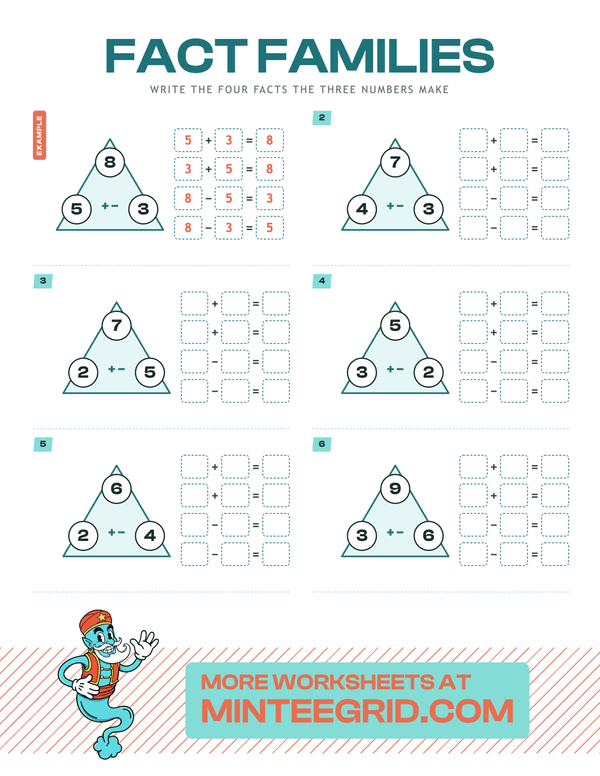
Try it yourself
Fact Families
Three numbers in a triangle and the four facts they make — addition and subtraction, or times and divide. Math · 6–9 years.
The common mix-ups
- Writing 3 − 8 = 5. The child kept the numbers but lost the order. Remind them: subtraction starts with the whole — the biggest number, the one at the top.
- Writing the same fact twice. 3 + 5 = 8 and 3 + 5 = 8. Ask: "What happens if you swap the two parts?" That's the second fact.
- Mixing up the parts and the whole. Ask which two numbers make the third. The answer is always the two at the bottom.
Where fact families lead
Fact families connect to number bonds — the same part-part-whole idea drawn as circles — and later to missing-number equations like ☐ + 5 = 13. That last one is early algebra, and children who know their fact families solve it without ever being told it's algebra.
For the counting strategy that comes right before this, see the make-a-ten strategy.
FAQ
What is a fact family in math?
A fact family is a group of three numbers and the related facts they make. For addition and subtraction, 3, 5 and 8 make 3 + 5 = 8, 5 + 3 = 8, 8 − 5 = 3 and 8 − 3 = 5. For multiplication and division, 4, 6 and 24 make 4 × 6 = 24, 6 × 4 = 24, 24 ÷ 6 = 4 and 24 ÷ 4 = 6.
Why do fact families only have two facts sometimes?
When the two parts are the same number — a double like 4 + 4 = 8 — turning it around gives the same fact. So 4, 4 and 8 make only 4 + 4 = 8 and 8 − 4 = 4. That's why practice sheets usually leave doubles out.
What grade learns fact families?
First grade, for addition and subtraction within 20: understanding subtraction as an unknown-addend problem (1.OA.4) and using related facts (1.OA.6). Third grade does the same for multiplication and division (3.OA.6).
How do I know which number goes at the top of the triangle?
The biggest one — the whole. In addition and subtraction it's the sum; in multiplication and division it's the product. The two numbers at the bottom are the parts that make it.