The make-a-ten strategy: how first graders add 8 + 5 without counting
October 12, 2026 · 6 min read
Making a ten turns 8 + 5 into 10 + 3. Eight needs two more to reach ten, so split the five into two and three. Eight and two make ten; ten and three make thirteen. No counting, no fingers, and the answer comes from facts the child already knows. It's the most useful mental math strategy in first grade, and the one behind most "fast" adding later on.
Why ten?
Because our number system is built on it. Ten plus anything is trivial: 10 + 3 = 13, 10 + 7 = 17. A child who can get any problem to "10 plus something" has turned every addition fact within 20 into an easy one.
What has to come first
Make a ten has two prerequisites, and skipping them is why it sometimes doesn't work:
- The pairs that make 10, instantly: 1 + 9, 2 + 8, 3 + 7, 4 + 6, 5 + 5. If a child has to count to find what goes with 8, the strategy is slower than counting the whole problem.
- Splitting small numbers. 5 is 2 and 3, or 1 and 4. Number bonds are exactly this.
Lifehack: practice "make 10" pairs as a call-and-response in the car. You say "seven," they say "three." Thirty seconds a day for two weeks and the pairs are automatic — which is when make a ten starts to pay off.
Ten frames are the classic tool for the pairs: a frame with 7 dots shows the 3 empty squares that make 10. Number bonds cover the splitting.
Practicing the strategy itself
Once the pairs are solid, walk through a few problems out loud:
- 9 + 4: 9 needs 1. Split 4 into 1 and 3. 10 + 3 = 13.
- 7 + 6: 7 needs 3. Split 6 into 3 and 3. 10 + 3 = 13.
- 8 + 7: 8 needs 2. Split 7 into 2 and 5. 10 + 5 = 15.
Lifehack: start from the bigger number. 4 + 9 is easier as 9 + 4 — the 9 only needs 1 to make ten. Turning the problem around is allowed, and it's a good moment to point out that addition works in either order.
Lifehack: use an egg carton with two cups cut off — that's a ten frame you can hold. Put in 8 beans, then add 5 more: the first 2 fill the frame, the other 3 spill over. The child sees "10 and 3" without being told.
Games that build it without worksheets
- Make 10 hunt: deal out playing cards (face cards removed) and find pairs that sum to 10.
- Sum search: a grid of digits where the child circles every pair that adds to 10. Our Sum Search sheets are built around exactly this, and it's surprisingly absorbing.
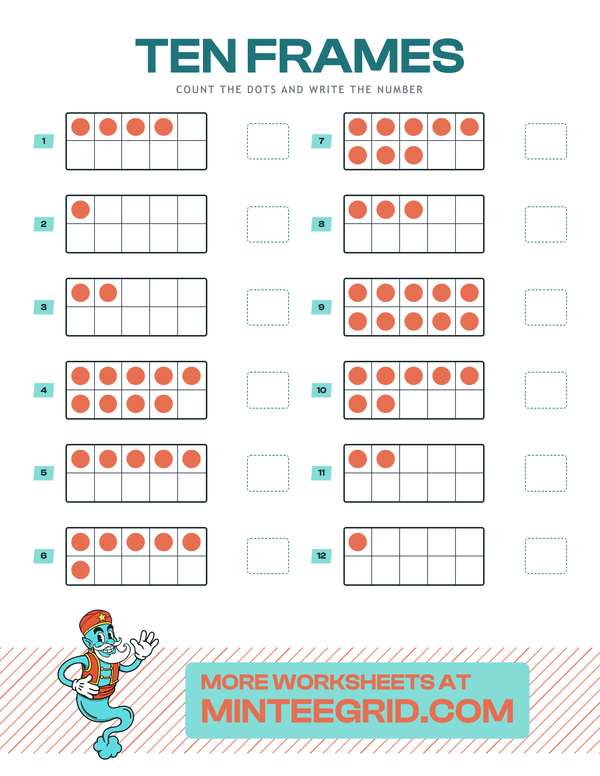
Try it yourself
Ten Frames
Count the dots, draw the dots, or say how many more make ten. Math · 4–6 years.
What it leads to
Make a ten extends naturally: 38 + 5 is 38 + 2 + 3 = 43, and 47 + 6 is 47 + 3 + 3 = 53. It's the same move with a bigger number, and it's how adults add in their heads. A child who owns it in first grade has the foundation for mental math through the end of elementary school.
For the subtraction side of the same idea, see fact families.
FAQ
What is the make-a-ten strategy?
Breaking one addend apart so the other one reaches 10. For 8 + 5: 8 needs 2 more to make 10, so split 5 into 2 and 3. Then 8 + 2 = 10, and 10 + 3 = 13. It turns a hard fact into an easy one.
What grade learns making ten?
Kindergarten learns the pairs that make 10 — finding the number that makes 10 with any number from 1 to 9 (K.OA.4). First grade uses making ten as a strategy to add and subtract within 20 (1.OA.6).
What does a child need to know before using make a ten?
The pairs that make 10 (1 and 9, 2 and 8, 3 and 7, 4 and 6, 5 and 5) by heart, and how to split a small number into two parts. Without those, the strategy is slower than counting.
Does make a ten work for subtraction?
Yes — it's called 'decomposing to ten' or 'subtract to ten.' For 13 − 5: take 3 to get to 10, then 2 more to get to 8. Many children find it easier through addition: 5 + ? = 13.