How kids learn to count: the stages from one to ten
October 20, 2026 · 6 min read
A toddler who chants "one, two, three, four, five" is not counting yet — they are singing. Real counting needs five ideas working together, and children pick them up one at a time.
The five ideas
- Stable order — the number words always come in the same order.
- One-to-one — one number word for each thing, no skipping, no doubling.
- Cardinality — the last number you say is how many there are.
- Any order — you can count the things in any order and get the same answer.
- Anything counts — sounds, jumps, ideas, not just objects.
Most children have the first by three and all five by five. The big moment is cardinality: the day a child counts five blocks and, asked "how many?", says "five" instead of counting again.
Lifehack: after your child counts, ask "so how many are there?" If they start counting again, cardinality has not clicked yet — and that is fine. Ask every time and it will.
Seeing without counting
Subitizing is knowing how many at a glance — a die's five, three apples. It grows alongside counting and is the root of quick mental math. Dice games and dot cards build it.
What to practice when
- Toddlers: counting songs, counting stairs, touching each one.
- Preschoolers: counting objects into a cup, matching numbers to groups.
- Kindergarten: counting to 100, counting groups and comparing them, writing the numbers.
On paper
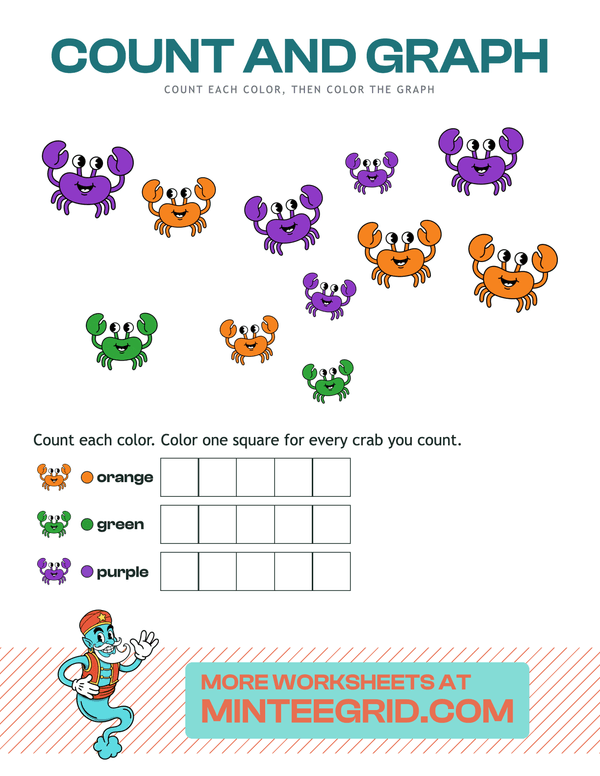
Counting a scattered group is harder than counting a row — nothing tells you where to start. Count and Graph and More or Fewer? both scatter a picture across the page; a child learns to cross off each one as it is counted. For counting in rows, try Ten Frames and Tally Marks.
Try it yourself
Count and Graph
Count each color, then color one square of the graph for every one you find. Math · 4–7 years.
FAQ
At what age can a child count to 10?
Many children can recite to ten by about three, and count ten objects correctly — touching each one once and knowing the last number is the total — by about four or five.
What is the difference between rote counting and counting?
Rote counting is saying the number words in order, like a song. Real counting is matching one number to each object and knowing the last number tells how many there are.
What is subitizing?
Seeing how many are in a small group at a glance, without counting — like knowing a die shows five. Children can usually subitize up to three or four by kindergarten.