Math fact fluency in five minutes a day
October 12, 2026 · 7 min read
Math fact fluency means answering a basic fact — 7 + 8, 13 − 6, 6 × 7 — in about three seconds, without counting. It isn't about being fast for its own sake. A child who has to count out 7 + 8 spends their attention on that, and has none left for the regrouping, the word problem or the order of operations the fact is part of.
The good news: it takes a few minutes a day, not an hour.
Why five minutes beats thirty
Memory works on repetition spread out over time, not on volume crammed into one sitting. Five minutes every day for a month moves facts into long-term memory far better than two long sessions a week. Short sessions also end before a child gets tired and starts guessing — and guessed practice teaches wrong answers.
Lifehack: attach the five minutes to something that already happens every day — right after breakfast, or while dinner is cooking. A routine that needs no decision is a routine that survives a busy week.
The five-minute routine
- Minute 1 — warm up with five facts the child already knows. It starts the session with success.
- Minutes 2–4 — the working set: eight to ten facts that are still slow, mixed with a few known ones. This is where learning happens.
- Minute 5 — one fast round of the working set, or a short sheet. Mark which came back instantly.
Next day, retire the facts that were instant three days running and add the next few slow ones. The working set is always small and always moving.
What to drill first
Not all facts are equally hard, and the order matters.
Addition: plus 1 and plus 2, then doubles (6 + 6), then make-ten pairs (7 + 3), then near-doubles (6 + 7 is double 6 plus 1), then the rest. The make-a-ten strategy handles most of what's left.
Multiplication: ×2, ×5, ×10 first, then squares, then ×9 (finger trick), then the hard middle — 6×7, 6×8, 7×8. Our guide on memorizing the times tables goes through this order in detail.
Lifehack: turn every fact into its pair. Drill 6 × 8 and 8 × 6 together, and 13 − 5 alongside 5 + 8. A fact and its turnaround or its fact family are one piece of knowledge — practicing them apart doubles the work.
How to spot "fluent" versus "fast counting"
Watch, don't just check answers. A correct answer after a pause, lips moving or fingers tapping is still being counted. That's fine — it's just not fluent yet, and the fact stays in the working set. Fluent is: the answer comes back before the child seems to think about it.
What about timed tests?
Timed tests have a bad reputation, and some of it is earned: a public, high-stakes timed test can make a child anxious, and anxiety blocks recall. But a private timer, where the only competition is yesterday's score, is a different thing. Many children enjoy beating their own time.
Lifehack: time the same short sheet type every day and record the time on a chart. Watching their own line go down motivates most kids more than any sticker — and it's evidence for them, not for a grade.
If the clock causes tears, drop it. The repetition is what builds speed; the timer only measures it.
Fresh sheets, every time
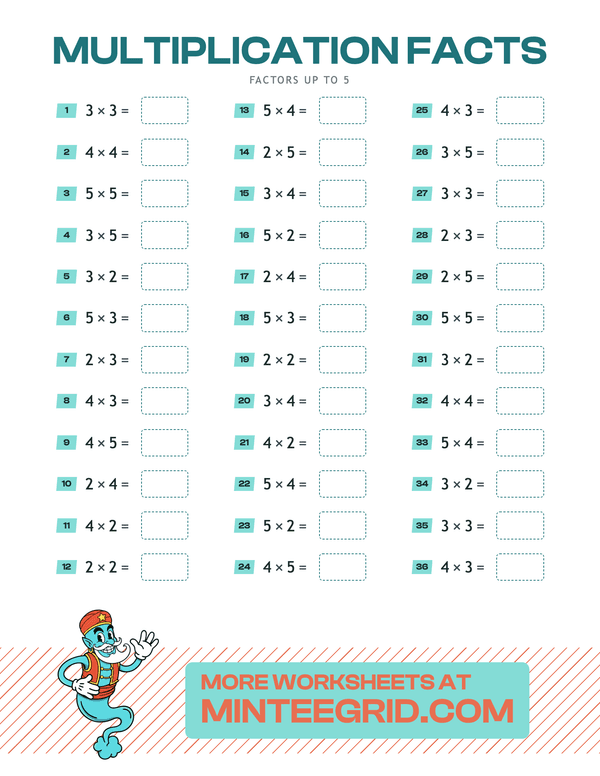
A reused sheet lets a child memorize where the answers are instead of what they are. New problems in the same range every day keep the practice honest. That's what generated sheets are for — multiplication facts, division facts and mixed addition and subtraction all produce a new set with each click, in the exact range being drilled.
Try it yourself
Multiplication Facts
Times tables with configurable factor range. Math · 7–9 years.
FAQ
What is math fact fluency?
Being able to answer basic facts — addition and subtraction within 20, multiplication and division within 100 — accurately and quickly, in about three seconds, without counting or working it out. It frees attention for the harder parts of a problem.
When should kids be fluent with math facts?
US standards expect fluent addition and subtraction within 10 by the end of first grade (1.OA.6), within 20 by the end of second grade (2.OA.2), and multiplication and division within 100 by the end of third grade (3.OA.7).
Are timed math tests bad for kids?
They can cause anxiety when they're high-stakes or public. A short, private, low-pressure timer — the child racing their own yesterday — is usually fine and even motivating. If timing causes tears, drop the clock and keep the daily practice; speed comes from repetition anyway.
How long does it take to learn math facts?
With five to ten minutes of daily practice focused on the facts that are still slow, most children make the jump for one set — say, the addition facts within 20 — in four to eight weeks. Missing days slows it more than shorter sessions do.