Name mazes for a whole class — a teacher's guide to making one per child
September 6, 2026 · 9 min read
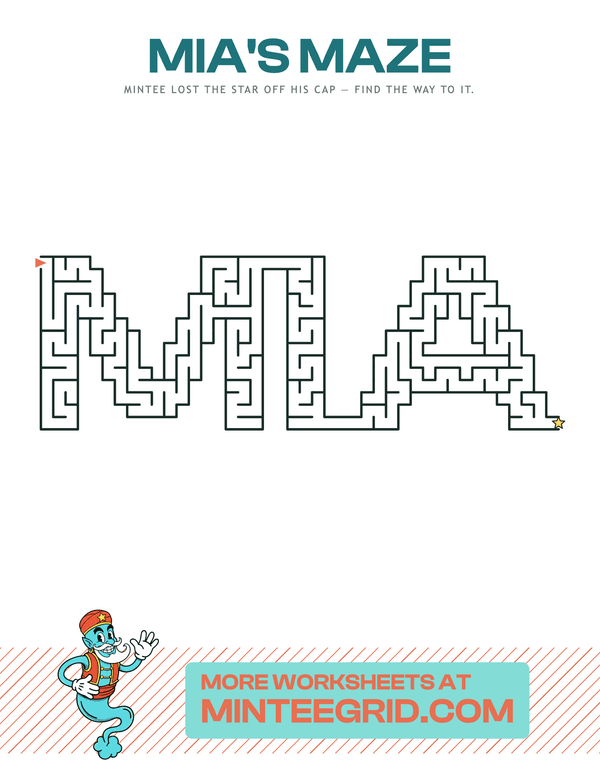
There is a specific moment on the first morning of a school year when a teacher needs twenty-five different pieces of paper, each one obviously belonging to one particular child, and needs them to be worth doing rather than just decorated. A name maze is that: the child's own name spelled across the page in letters made of corridors, with a single route running from the first letter to the last.
This is the practical guide to making a set of them. It covers the whole workflow, the cost, and — because it matters more than either — the two places where the process is slower or more awkward than you would guess from the form.
What a name maze actually is
Not one sheet per letter. That is the obvious way to build this and it is the wrong one: a child called Sebastian would get nine pages, which is nine puzzles that happen to spell something rather than one puzzle about their name.
Instead the whole name goes on one page. The letters are laid out, joined by short corridors, and exactly one route runs from the arrow at the start of the first letter, through every letter in order, to the star at the end of the last. A child solving it traces the shape of their own name from beginning to end without ever being told that is what they are doing.
That has a consequence worth stating plainly, because it decides the cost: one name is one sheet. Anna and Sebastian cost the same.
The workflow, step by step
- Open the name maze generator.
- Type the first child's name in the name field. It accepts two to twelve letters, no spaces.
- Pick a path width — see the table below for which one suits your year group.
- Leave the sheet count at 1. You want one sheet of THIS name, not twenty of it.
- Turn on Name & date line if you want the header rule at the top of the page.
- Generate, download, and move to the next child.
That is roughly thirty seconds per name once you have the rhythm, so about twelve minutes for a class of twenty-five, plus printing.
Lifehack: do the whole class in one sitting into a single folder, then print the folder in one go rather than printing after each name. The per-name step is fast; it is the twenty-five separate trips to the printer dialog that turn a twelve-minute job into a forty-minute one.
Choosing one path width for a whole room
You are choosing one setting per child, so you can genuinely vary it — a class set does not have to be uniform the way a batch of identical mazes does. In practice most teachers pick one width for the room and step it up or down for two or three children.
| Year group | Path width | What the sheet is really doing |
|---|---|---|
| Pre-K / Reception | Wide | A pencil-control exercise with their name as the track. Few junctions, big letters. |
| Years 1–2 | Wide or Medium | Letter recognition sideways — they trace the shape of each letter without being asked to. |
| Years 3–4 | Medium | A real puzzle. Enough junctions to need a plan, still finishable in a settling slot. |
| Years 5–6 | Narrow | Genuinely hard. Long names at this setting will occupy a fast finisher for a while. |
The width is the only difficulty control, and it does two jobs at once here: it sets how much room the pencil has AND how big the letters end up, because the sheet is sized from the name rather than the name squeezed into a fixed grid. Narrower corridors mean more corridors per letter, not smaller letters.
What it costs for a class
One token per name, and tokens are cheaper per unit in larger bundles. The arithmetic for common class sizes:
| Class size | Sheets | What to buy |
|---|---|---|
| 12 | 12 | One bundle covers it with a few spare |
| 20 | 20 | One bundle, nothing left over |
| 25 | 25 | One bundle plus a small top-up |
| 30 | 30 | One larger bundle |
Two things worth knowing before you start. Length does not change the price — this is the whole reason the generator puts a name on one sheet rather than one letter per sheet. And a mistyped name costs a token to redo, which is the argument for the checking step below rather than for typing carefully at speed.
The two awkward parts, honestly
Neither of these is a reason not to do it. Both are much easier to handle before you sit down than in the middle of a print run.
Names are entered one at a time. There is no paste-a-class-list field yet. Twenty-five names is twenty-five passes through the form, and while each pass is short, it is a repetitive twelve minutes and worth doing with the register open beside you rather than from memory.
The field takes A–Z only. No spaces, no hyphens, no apostrophes, no accents. That is a design decision about what can be cut into a maze and drawn legibly, not an oversight — but it means you have to decide in advance what to do about:
- Accents — Zoë, José, Chloë. Use the plain-letter form: ZOE, JOSE, CHLOE.
- Hyphens — Mary-Kate can be MARYKATE (ten letters, fits) or MARY. Ask the child which they write on their own work.
- Apostrophes — O'Brien becomes OBRIEN.
- Very long names — the ceiling is twelve letters. Christopher fits at eleven; Konstantinos does not. Use whatever the child is actually called day to day, which is usually shorter and always more welcome.
- Two children with the same name — nothing to do. Generate twice; the two sheets will be different mazes through the same letters.
Where these actually earn their keep
The first week of term. Every child gets a sheet that is unmistakably theirs on a morning when nothing else is. It also quietly tells you who can and cannot yet recognize their own name in capitals, which is a useful thing to learn in week one.
Name recognition in Reception. The point of the sheet is not the maze; it is the twenty minutes a four-year-old spends following the outline of their own name with a pencil. That is letter-shape practice that does not feel like letter-shape practice.
A birthday. One sheet, thirty seconds, and it is about that child.
Supply cover and settling slots. A set of these in a drawer is a five-minute activity that needs no explanation and cannot be finished by copying, because no two sheets are the same puzzle.
Display. Twenty-five solved name mazes on a wall reads as a class list that the class made.
What it will not do
It is not a phonics activity. There is no sound-letter work in it and no writing — the child traces a route, they do not form the letters. If you want the sheet to carry the alphabet more directly, the letter maze does one letter at a time at full page size, which is a better fit for a letter of the week.
It also will not fill a lesson. It is a settling activity, an early-finisher task, or a first-morning icebreaker. Fifteen to twenty minutes at Medium, less at Wide.
Try it yourself
Name Maze
Type a name and get one maze that runs through every letter of it. Mazes · 4+ years.
A checklist before you start
- Register open, so you spell names the way the child does
- Decisions made in advance for accents, hyphens and long names
- One path width chosen for the room, with two or three exceptions noted
- Sheet count left at 1 for every generation
- All names generated first, printed once at the end
Related
- Printable mazes for a classroom — the case for twenty different sheets rather than twenty copies
- How hard should a maze be? — choosing one setting for a room full of different hands
- Printing tips for crisp sheets — getting a class set out of one cartridge
- Printable mazes by age — the shape-by-age ladder
FAQ
Can I make a name maze for every child in my class?
Yes. Each child needs their own generation, because the name is what the maze is made of — you type a name, generate, and get one sheet whose route runs through every letter of it. For a class of twenty-five that is twenty-five short passes through the form, about twelve to fifteen minutes end to end including printing.
How much does a set of name mazes for a class cost?
One token per name, whatever the name's length. A four-letter name and a nine-letter name are both one sheet and both one token, because the whole name goes on a single page. Tokens are cheaper in larger bundles, so a class set is bought as one bundle rather than twenty-five separate purchases.
Do long names still fit on the page?
Yes, up to twelve letters. Names longer than about five letters are laid out over two or three lines so the letters stay big enough to have a maze inside them — a nine-letter name across a single line would leave each letter nineteen millimeters wide, which is not a puzzle any more.
Can two children with the same name get different sheets?
Yes, and they will by default. Nothing is pre-drawn, so generating ANNA twice produces two different mazes through the same letters. Two children called Anna get their own puzzle each rather than one sheet photocopied twice.
What about a child whose name has an accent, a hyphen or an apostrophe?
The field takes A–Z only, so type the plain-letter form: Zoë becomes ZOE, Mary-Kate becomes MARYKATE or just MARY. It is worth deciding this before you start rather than in front of the child — see the section on awkward names below.
Is there an answer key for each one?
Yes, as a toggle on the form. The key prints after the puzzle as its own page, so on a class set you can print only the front pages and keep the keys, or skip generating them entirely.