Printable mazes for kids, by age — which one to print at 3, 5, 7 and 9
August 11, 2026 · 7 min read
Most maze packs sold for children are sorted by nothing at all, or by a vague "ages 4–8" printed on the cover. That is not much help when you are standing at a printer trying to decide. Here is the version we would actually give a friend.
The short answer, if you want only that:
- 3–4 — classic maze, widest corridors, one to a page
- 4–6 — circular maze, medium corridors
- 6–8 — classic or triangle, medium to narrow
- 8+ — hexagon maze, any width
The rest of this is why, and how to tell when a child has moved on.
3 to 4: the maze is a pencil exercise
At this age the puzzle is not the puzzle. A three-year-old drawing a maze is practicing keeping a pencil between two lines for the length of a page, and the corridors have to be wide enough that this is achievable — a fat pencil in a small fist needs room to be wrong.
Print a rectangular maze at the widest setting. That is about eight cells across, with corridors you could comfortably write a letter inside. There will be few enough junctions that route-finding barely comes into it, which is correct: everything a child gets out of this sheet is in the drawing.
The tell that they are ready for more is not that they finish. It is that they stop at a junction and look before choosing. That is route planning showing up, and it means the sheet has started doing a second job.
4 to 6: the goal in sight
A circular maze is the odd one out of the four, and it is the one we would reach for at four or five. The exit is the middle, so it is visible from the moment the sheet lands on the table — a child always knows which way counts as progress, and never has that flat "I don't know where I am" moment a rectangular maze can produce halfway across.
That sounds like a small thing and is not. It removes an entire layer of difficulty while keeping all the route-finding, which is exactly the trade you want at four.
Four small circles on one page also works well here, because finishing something four times in a sitting is worth more to a five-year-old than finishing something once.
6 to 8: more turns, not thinner walls
This is where most maze packs go wrong. The obvious way to make a maze harder is to shrink it, and shrinking it changes the wrong variable — a narrower corridor tests the hand, not the head.
Raise the number of turns first. A rectangular maze at medium corridors is around fourteen columns and holds a route deep enough to need remembering, without asking anything new of the pencil. A triangular maze is a good pick at this age too: three ways out of every cell instead of four, but the cell flips upside down at every step, so the child cannot settle into a strategy like "keep to the right." The shape of the choice itself keeps changing.
Lifehack: if a child solves a maze quickly but complains it was hard, they are usually telling you about the corridor width. If they solve it slowly and say it was easy, they were enjoying it and the difficulty is about right. The complaint is more reliable than the clock.
8 and up: change the geometry
By eight, a child who does mazes regularly can solve a square one of almost any size without much effort, and making it bigger just makes it longer. The fix is to change what a cell is.
A hexagonal maze gives six ways out of every cell rather than four, so a wrong turn is one choice in five instead of one in three — and two of the six lead diagonally backwards, so mistakes take longer to notice. There is also not one straight corridor on the sheet: a passage that looks like it runs across the page is actually zig-zagging, which kills the usual trick of scanning ahead down a line. It is comfortably the hardest sheet we make.
Printing for a class rather than a child
If you are printing for more than one child, the age question changes shape: you need the same difficulty at different sheets, not different difficulties. Every maze here is generated per request, so twenty prints at the same settings are twenty different mazes — nobody can look sideways and copy, and nobody gets the one that has already been round the room.
Try it yourself
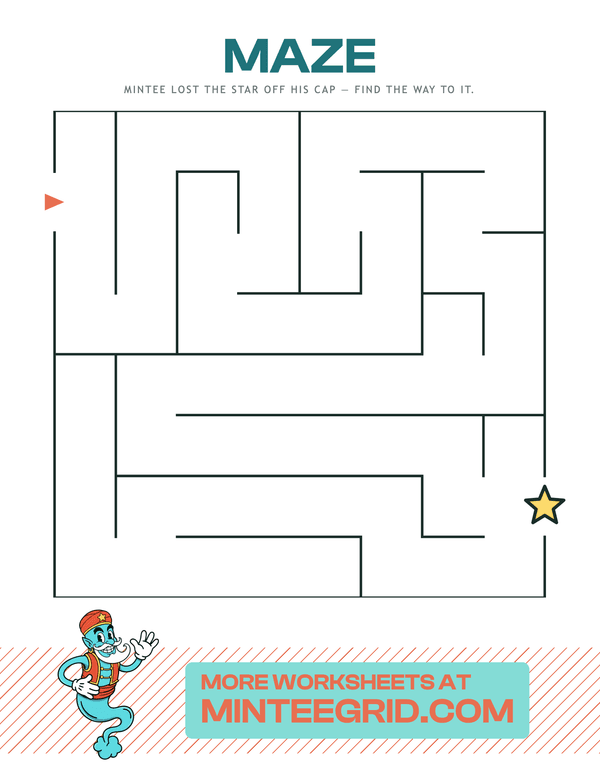
Classic Maze
One way in, one way out — and never the same maze twice. Mazes · 3+ years.
Related
- What a maze actually teaches — the four separate skills hiding inside "find the way out"
- How hard should a maze be? — corridor width versus number of turns, and why they are not the same dial
- Mazes before handwriting — the pre-writing case for the widest settings
- A parent's guide to picking difficulty — the general version, across every generator
FAQ
What is a good first maze for a 3-year-old?
A rectangular maze at the widest corridor setting — about eight cells across, corridors wide enough to draw down without touching the sides. At three the exercise is keeping a pencil inside a line, not finding a route, so the maze wants few junctions and lots of room. If the sheet still ends in frustration, the problem is almost never the puzzle; it is the width of the gap the pencil has to stay inside.
When can a child do a hard maze?
Sooner than most people expect, if "hard" means more turns rather than narrower corridors. A six-year-old with decent pencil control can work through a twenty-column maze quite happily. The same child on a maze with 5mm corridors will struggle for a reason that has nothing to do with the puzzle. Raise the number of turns first and the corridor width last.
Is a circular maze harder than a square one?
Different, and often easier for a young child even at the same cell count. The goal sits in the middle and is visible from the first second, so there is never any confusion about which direction counts as progress — which removes a whole layer of difficulty that a rectangular maze quietly adds.
My 9-year-old finds every maze boring. What now?
Change the geometry rather than the size. A hexagonal maze gives six ways out of every cell instead of four and has no straight corridors to skim along, which is a genuine step up rather than the same puzzle drawn smaller. A triangular one flips the cell over at every step so "keep going right" stops working as a strategy. Both usually land with a child who has stopped finding square mazes interesting.