PEMDAS mistakes: why multiplication doesn't always come before division
October 12, 2026 · 6 min read
PEMDAS — Parentheses, Exponents, Multiplication and Division, Addition and Subtraction — is the order of operations nearly every US student learns. The rule is right. The way it's usually remembered isn't, and that's where the most common mistake comes from.
The trap hiding in the acronym
"Please Excuse My Dear Aunt Sally" puts M before D and A before S. So children reasonably conclude that multiplication comes before division and addition before subtraction. It doesn't.
Multiplication and division are a tie. Do whichever comes first, reading left to right. Same for addition and subtraction.
- 12 ÷ 3 × 2 = 8 (divide first, because it's first). Not 2.
- 10 − 4 + 3 = 9 (subtract first). Not 3.
Lifehack: write PEMDAS as a staircase of four steps, not six letters: P / E / MD / AS — with M and D sharing a step, and A and S sharing one. Then say "on the same step, go left to right." The picture does what the mnemonic doesn't.
Some teachers skip PEMDAS for GEMS — Grouping, Exponents, Multiply or divide, Subtract or add — precisely because four steps can't be misread as six.
The second trap: doing everything at once
The other common error is trying to do the whole expression in one pass, mentally, and losing a piece. 3 + 4 × 2 − 1 gets done as "seven, fourteen, thirteen" — doing the addition first because it came first.
The fix: one operation per line. Rewrite the expression after every single step:
3 + 4 × 2 − 1
3 + 8 − 1
11 − 1
10
It looks slow. It's actually faster than finding the mistake afterward, and it makes every step checkable.
Lifehack: before solving, have your child number the operations in the order they'll do them — a small 1, 2, 3 above each sign. Planning the order first and calculating second separates the two skills, and most errors were planning errors.
Why the order matters at all
Children reasonably ask why there's a rule. The honest answer: so that everyone gets the same answer from the same expression. A useful demonstration is a problem that changes if the order is ignored. 2 + 3 × 4 is 14 by the rule and 20 left-to-right. Seeing two different "answers" makes the case for a shared rule better than any explanation.
Every problem on our order of operations sheets is built that way: it gives a different answer if the order is ignored, so a child can't get it right by accident.
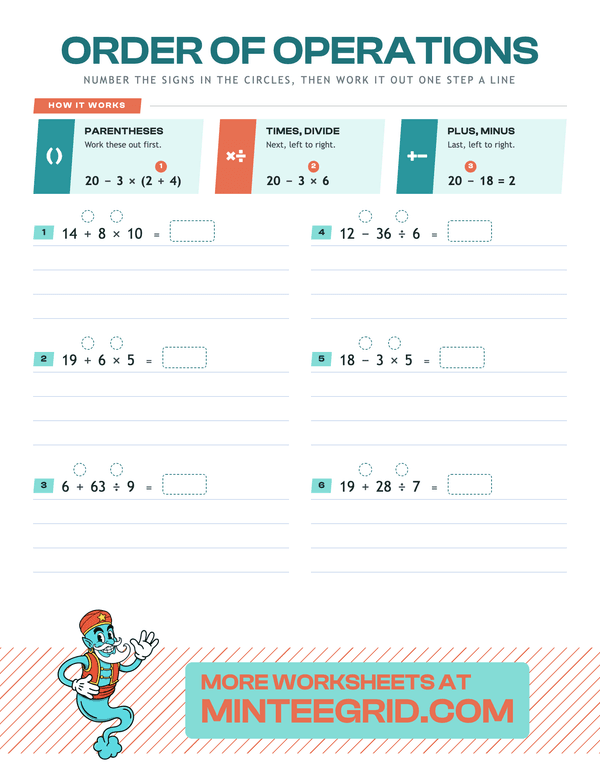
Try it yourself
Order of Operations
Number the signs first, then work it out one step a line. Every problem changes if the order is ignored. Math · 9–12 years.
A short practice plan
- Two operations, no parentheses — 6 + 3 × 2. Is the multiplication really done first?
- The tie cases — 20 ÷ 4 × 5, 15 − 6 + 2. Left to right on the same step.
- Parentheses — (6 + 3) × 2. Grouping beats everything.
- Mixed, four operations — the full rule. Mixed math crosswords are a good change of pace here: a wrong order produces a digit that doesn't fit the crossing answer.
For the arithmetic underneath it all to be quick enough that the order is the only thing to think about, see math fact fluency in five minutes a day.
FAQ
What does PEMDAS stand for?
Parentheses, Exponents, Multiplication and Division, Addition and Subtraction. It's often remembered as 'Please Excuse My Dear Aunt Sally.' Multiplication and division are one step, done left to right; so are addition and subtraction.
Does multiplication come before division in PEMDAS?
No. Multiplication and division have the same rank and are done in the order they appear, left to right. In 12 ÷ 3 × 2, divide first because it comes first: 4 × 2 = 8, not 12 ÷ 6 = 2. The same goes for addition and subtraction.
What grade learns order of operations?
Third grade meets it informally with two-step problems (3.OA.8). Fifth grade uses parentheses, brackets and braces in expressions (5.OA.1), and sixth grade adds exponents (6.EE.1–2).
What is GEMS instead of PEMDAS?
GEMS — Grouping, Exponents, Multiply or divide, Subtract or add — is an alternative some teachers prefer. It has four steps instead of six, which makes it harder to think multiplication comes before division.