What a maze actually teaches — it isn't finding the way out
August 4, 2026 · 6 min read
A maze looks like a spatial puzzle, and the way most people describe it — "find the way out" — makes it sound like one skill. Watch a five-year-old actually do one and you see four separate things happening, only one of which is spatial. Which of the four a child is finding hard tells you exactly what to print next, and it is usually not "an easier maze."
The four things happening at once
Route planning. Looking ahead down a corridor and deciding, before the pencil moves, whether it goes anywhere. This is the part people mean by "solving a maze," and it is the last of the four to arrive.
Working memory. Holding the plan while carrying it out. A child who plans a good route and then forgets it two turns in has a memory problem, not a maze problem — and the tell is that they solve short mazes fine and fall apart on long ones at the same corridor width.
Error recovery. Hitting a dead end, recognizing it as a dead end, and going back. This sounds trivial and is the single most transferable thing on the list. A child who treats a wrong turn as information rather than as failure is learning something that outlasts the sheet by twenty years.
Motor control. Keeping a pencil inside two lines for the length of a page. For a three- or four-year-old this is most of the work, and everything above it is barely engaged.
Why that matters when you print the next one
The four do not develop together, and the same maze exercises them in wildly different proportions depending on its shape.
A wide-corridor maze is almost entirely motor control. There are few enough junctions that route planning barely engages — which is the point at three or four, and a waste of paper at eight.
A long, narrow maze leans on working memory. The route is many turns deep, so the child has to keep a plan alive rather than see the whole thing at a glance.
A circular maze is unusual: the goal is visible from the first second, so route planning gets a much bigger share of the work than usual, and the child is never disoriented about which direction counts as progress. That is why it often lands well with a four-year-old who bounces off a rectangular maze of the same difficulty.
A hexagon maze hammers error recovery. Six ways out of every cell means a wrong turn is one choice in five rather than one in three, and two of those go diagonally backwards — mistakes take longer to notice, so noticing them is most of the exercise.
Lifehack: if you want to see which of the four is the weak one, print the same maze twice and let the child do the second copy the next day. A route-planning problem produces a different (still slow) attempt. A working-memory problem produces a much faster one, because the route is now partly remembered. That difference tells you more than watching a single attempt ever does.
The part nobody mentions: the second attempt
Almost every maze a child meets is from a book or a printed pack, which means it can only be solved once. The second time through, they are not solving anything — they are remembering where the turns were. That is a fine activity, it just is not the activity anyone thinks they are buying.
This is the whole reason our mazes are generated per request rather than drawn once: the same settings produce a different maze every time, so a child can do their fifth wide maze this week and still be planning a route rather than recalling one. It also means a class of twenty gets twenty different sheets from one print run, which matters more to a teacher than to a parent.
What a maze does not do
It does not teach a subject. A maze is a domain-free exercise — there is no arithmetic in it, no letters, no facts. That is a genuine limit, and it is why the honest place for mazes in a week is next to something with content in it rather than instead of it.
If you want the same planning-and-persistence feeling with a subject inside it, Crack the Code does the closest thing: the mechanic is decoding rather than route-finding, but the "keep going, you are getting somewhere" shape of it is the same, and there is arithmetic underneath.
Try it yourself
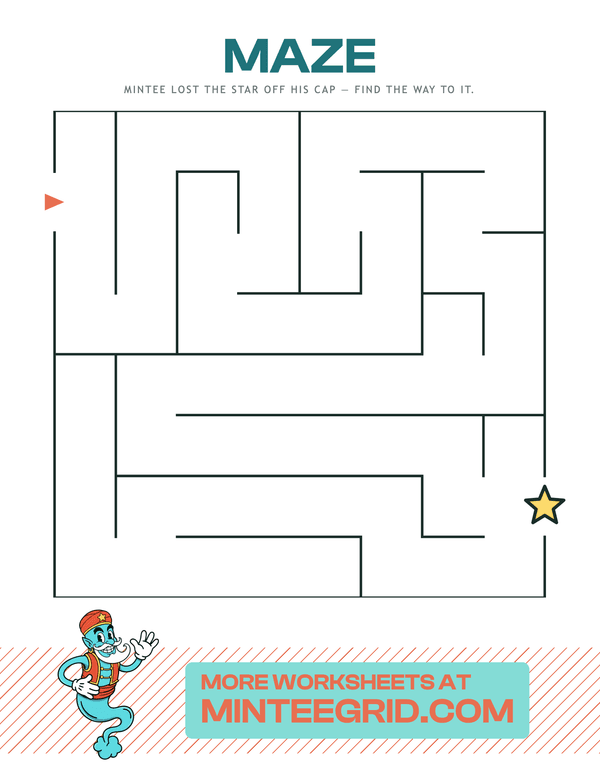
Classic Maze
One way in, one way out — and never the same maze twice. Mazes · 3+ years.
Where to start
If you are new to this and want one decision rather than four, start with a classic maze at the widest corridor setting and watch the first thirty seconds. A child who draws straight into the first wall is telling you about motor control. A child who stops at the first junction and looks is telling you they are ready for something with more junctions in it.
Everything after that is covered in the guide to picking a maze by age, and the specific question of how wide to make the corridors has its own piece.
FAQ
What age can a child start doing mazes?
Around three, if the corridors are wide enough to draw down without hitting the walls. At that age it is a pencil exercise with a story attached rather than a puzzle — the child is practicing staying inside a line, and the maze just makes that worth doing. Real route-finding, where a child looks ahead and rejects a branch before drawing into it, usually shows up somewhere between four and six.
Should I let my child guess and backtrack, or make them plan first?
Let them backtrack. Trial and error is not a failure mode here, it is the mechanism — a child who runs into a dead end, notices, and reverses has just done the whole exercise. Planning ahead comes later and comes on its own, usually after enough dead ends that looking first starts to feel cheaper than drawing first.
My child draws through the walls. Is the maze too hard?
More likely the corridors are too narrow for their hand. Drop to a wider setting and see whether the wall-crossing stops. If it does, it was a motor problem, not a puzzle problem. If they still cut through walls at the widest corridor, they have probably understood the maze as "get to the star" rather than "get to the star along the paths" — worth saying out loud once, and then it usually sticks.
Are mazes actually educational or just a time-filler?
Both, honestly, and the time-filler part is not a criticism. What they genuinely practice is planning a route before committing to it, holding a plan in mind while executing it, noticing a mistake and reversing, and keeping a pencil inside a line. Those are real and they transfer. What they do not do is teach a subject, which is why they work best alongside something that does.