Worksheets for waiting rooms and long journeys
September 6, 2026 · 6 min read
There is a particular kind of dead time that every family knows: forty minutes in a waiting room, three hours in the back of a car, the queue at the passport desk, the hour before a delayed flight. The child is not tired enough to sleep and not free enough to run around, and the adult has run out of ideas.
A folder of printed sheets is unreasonably good at this, and for reasons that have nothing to do with education.
Why paper wins in these specific places
It needs no battery, no signal, no data and no table. It makes no sound and does not need to be turned down. It cannot be dropped and cracked. Nobody has to hold it up. It can be handed to a child in a queue and taken back thirty seconds later without a negotiation, which is not true of a phone.
And when it is finished it is finished — there is no next level, no autoplay, and none of the friction that comes with ending screen time in public.
None of that is an argument that paper teaches better. In a waiting room it does not need to.
What actually works away from a table
Wide corridors. This is the whole trick for a moving car. On a bumpy road the pencil jumps, and any sheet that requires a small accurate mark — a digit in a box, a letter on a line — becomes a source of frustration rather than a distraction from one. A maze with generous corridors is forgiving: being a few millimeters off the middle of the path costs nothing.
Something to lean on. A rigid surface is the difference between a sheet that gets done and a sheet that gets abandoned in five minutes. The folder itself, a hardback, a magazine — anything. This is worth more than any choice of worksheet.
Short. Two or three short sheets beat one long one, because the useful unit here is "something to finish", and finishing is the part that makes a child ask for another.
Variety. Three mazes is one activity. A maze, an I Spy scene and a code sheet is three, and it will last considerably longer than three times as long.
What to put in the folder
For a car journey:
- Two classic mazes at the widest setting — bumpy-road proof
- One animal maze — the shape does half the work of getting it picked up
- One I Spy scene — searching survives being interrupted, which arithmetic does not
For a waiting room:
- Two short mazes at a comfortable width, not a challenging one
- One name maze with the child's own name on it, which is the single most reliable way to get a worried child to engage with a piece of paper
- Something with an obvious ending, so there is a finish rather than an interruption
For a flight or a long wait:
- Five sheets of three different kinds
- One deliberately harder sheet at the bottom, for the point where everything easy has been done
Lifehack: print the folder the night before with the child watching and let them choose two of the sheets. A folder they helped assemble gets opened. A folder that appears from a bag at the worst moment gets refused, and often the refusal is about the moment rather than the sheets.
The back seat problem
Two children in a car with identical sheets produces an argument within about four minutes. It is always the same argument and it is not really about the worksheet.
The fix is that no two sheets here are ever the same. Every maze is generated when it is asked for, so two sheets at identical settings are two different puzzles — there is nothing to compare, nothing to copy, and no version of "he's got the same one as me". Two name mazes, one per child, removes the problem completely, because the sheets are visibly and permanently theirs.
What not to bother printing
Anything requiring precise small marks in a moving vehicle. Long multiplication in a car is a bad time for everyone.
Anything that needs explaining. If a sheet requires you to turn round from the front seat and describe the rules, it is the wrong sheet for a car. Mazes need no instruction beyond the arrow.
Anything the child has to be good at. Dead time is not the moment to stretch anyone. Print the level below the one they are working on.
Try it yourself
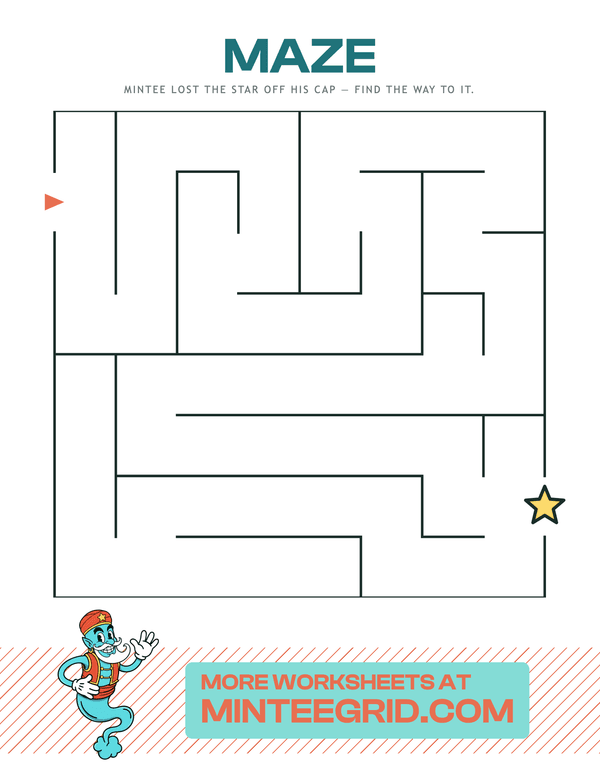
Classic Maze
One way in, one way out — and never the same maze twice. Mazes · 3+ years.
Related
- How long should a child work on a worksheet? — the attention you actually have
- Why worksheets beat screens for practice — the case for paper
- A maze made from your child's name — the sheet that is unmistakably theirs
- Printing tips for crisp sheets — getting a folder printed without wasting a cartridge
FAQ
What worksheets work best in a car?
Wide-corridor mazes. A moving car means a bouncing pencil, so anything requiring small marks — arithmetic, letter formation, tiny boxes — turns into frustration. A maze with generous corridors survives a bumpy road because being slightly off the line does not matter.
What should I print for a waiting room?
Two or three short sheets rather than one long one, at a width the child finds easy. A waiting room is an unfamiliar place with a worry attached, and it is the wrong moment to hand somebody a hard puzzle.
Do I need a clipboard?
Something rigid, yes. A magazine, a hardback book or the folder the sheets are in all work. It is the single biggest difference between sheets that get used away from a table and sheets that get abandoned.
How many sheets should I take?
Three to five, of different kinds. The variety matters more than the quantity — a child who finishes one maze often does not want a second maze, but will happily start an I Spy scene.