How long should a child actually work on a worksheet?
September 6, 2026 · 7 min read
The most common mistake with worksheets is not choosing the wrong one. It is expecting the right one to last twice as long as it should.
A parent sits a five-year-old down with a maze, the child finishes in six minutes, and the parent concludes the sheet was too easy. It was not. Six minutes is roughly what a five-year-old has.
What to actually expect
These are working numbers for sustained attention on a task an adult chose, which is the hardest case. On something the child picked themselves, add half again.
| Age | Realistic session | What that is in sheets |
|---|---|---|
| 3–4 | 5–10 minutes | One wide maze, or half of one and a return visit |
| 5–6 | 10–15 minutes | One maze at medium, or one I Spy scene |
| 7–8 | 15–20 minutes | One narrow maze, or a page of arithmetic |
| 9–11 | 20–30 minutes | Two sheets, or one hard one with a break in it |
The old rule of thumb — about two to five minutes of focus per year of age — is roughly right at the younger end and falls apart after about eight, where interest matters far more than age. Treat the table as a starting point and then watch the actual child, who is the only reliable instrument here.
The four signs the sheet ended
Attention does not run out cleanly. It degrades, and it degrades in a recognizable order. When you see these, the useful part is already over.
The pencil grip changes. It slides down toward the point, or up into a fist. This is the earliest sign and the most reliable one, because it is physical rather than emotional — the hand is tired before the child knows they are.
They start asking how much is left. Not "is this right" — "how many more". The question is about the end rather than the task.
Accuracy falls off a cliff rather than declining. A child who was solving carefully starts guessing. This is not carelessness; it is the point where checking costs more than they have.
They begin to decorate. Coloring the border, drawing on the margin, giving the star a face. Attention has moved to something easier and more rewarding. This is a perfectly good moment to stop, and it is worth saying so out loud rather than steering them back.
Short and often beats long and rare
Two ten-minute sessions on separate days do more than one twenty-minute session, for two separate reasons.
The first is that the second half of a long session is mostly spent on holding out rather than on the work. The second is that a child who finished feeling capable sits down more willingly next time, and a child who finished feeling ground down does not. Willingness compounds; twenty extra minutes does not.
The practical version: stop while it is still going well. A sheet abandoned at the good moment is worth more than a sheet completed at the bad one, and it is very hard for a parent to do because a half-finished page looks like a failure. It is not.
Lifehack: print two sheets at slightly different widths and let the child pick which one to do. Choosing costs nothing, takes four seconds, and reliably buys several extra minutes of attention — the session becomes something they started rather than something that was started at them.
When to change the difficulty instead of the timing
Giving up halfway through is not usually a persistence problem, and it does not respond to being encouraged to try harder. It is almost always a sheet that was one setting too hard.
The test is simple: hand the same child the same kind of sheet one width wider. If they finish it comfortably, the problem was the difficulty. If they stop at the same point, the problem is the length, and the fix is a shorter sheet or two mazes to a page rather than an easier one.
Both of those are one control on the form. How hard should a maze be goes into which setting means what, and a parent's guide to picking difficulty covers reading the child rather than the age label.
Sheets sized for the time you actually have
- Five minutes — a wide classic maze, or two mazes on one page, which is two short puzzles rather than one long one
- Ten minutes — a shaped maze at medium, or a name maze
- Twenty minutes — a narrow hexagon maze, or an I Spy scene with eight things to find
- A rainy afternoon — a batch of five different sheets rather than one long one, which respects the way attention actually works
Try it yourself
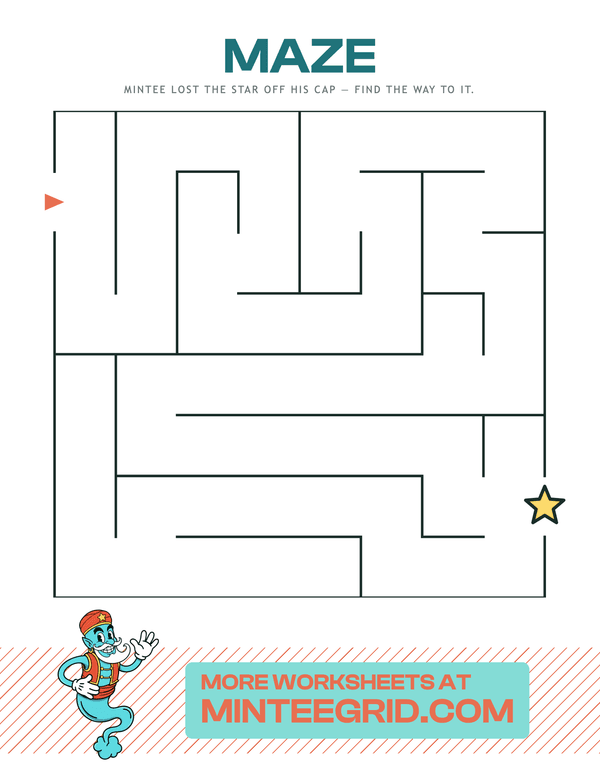
Classic Maze
One way in, one way out — and never the same maze twice. Mazes · 3+ years.
Related
- How hard should a maze be? — the width, and what it changes
- A parent's guide to picking difficulty — reading the child rather than the label
- Why worksheets beat screens for practice — the case for paper
- Printable mazes by age — the shape ladder
FAQ
How long should a 4-year-old work on a worksheet?
Five to ten minutes of genuine attention, and often less on a first attempt. A four-year-old who works for eight minutes and stops has done well — the number to aim for is one finished sheet, not a filled half hour.
How long can a 7-year-old concentrate?
Fifteen to twenty minutes on something they chose, less on something handed to them. That is enough for one medium maze or one page of arithmetic, which is why our sheets are sized the way they are.
Is it better to do one long session or several short ones?
Several short ones, and it is not close. Two ten-minute sessions on different days beat one twenty-minute session for both retention and willingness to sit down the next time.
My child gives up halfway. What should I change?
The difficulty, before anything else. Giving up halfway is almost always a sheet that is too hard rather than a child who lacks persistence — try one setting wider and see whether the same child finishes it.