A maze made from your child's name
September 6, 2026 · 6 min read
A four-year-old learning to recognize their own name will look at it hundreds of times before it goes in properly. Most of those looks are passive — it is on a peg, on a tray, on a book bag, and the child sees it without doing anything with it.
A name maze makes one of those looks active. The name is on the page in capitals, big, and the only way to finish the sheet is to travel along the inside of every letter in order.
One sheet, not one per letter
The obvious way to build this is a page per letter: A, then N, then N, then A. We built it that way first and it is wrong for two reasons.
It stops being about the name. Four separate puzzles that happen to spell something is not the same object as one puzzle that IS the name, and a child can tell the difference immediately.
And it prices a child by how long their name is. A family with a Mia would pay three sheets; a family with a Sebastian would pay nine, for the same worksheet. That is an absurd thing to charge for, and it is the reason the whole name goes on a single page: one name, one sheet, one token, whatever the length.
How the letters get onto the page
Three things happen automatically, and they are worth knowing because they explain why the sheet looks the way it does.
The letters are packed by their real width. An I takes less room than an M. Dropping every letter into an equal box would space a name out like A N N A, so each letter gets exactly the width its own shape needs.
Long names wrap. Nine letters across a single page would leave each one about nineteen millimeters wide, which is not enough to carve anything into. So a name of about five letters or more breaks over two or three lines, and the number of lines is whichever makes the letters biggest — for a four-letter name that is usually two lines of two, because the page is taller than it is wide.
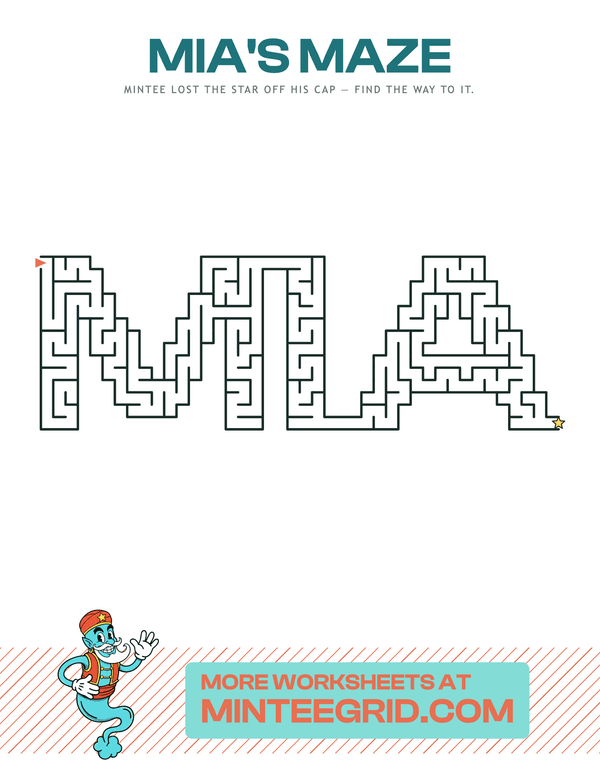
One rule overrides that: a line is never left with a single letter on it. MIA over two lines would be MI and A, which is not a name any more, so MIA stays on one line even though breaking it would make the letters taller.
The route runs through every letter in order. Where the name wraps, the line below is walked in the direction that keeps the join short, so the corridor between one line and the next is a hop between two letters that already sit one above the other rather than a wire dragged back across the page.
What difficulty means here
On every other maze we make, the difficulty control is the corridor width and the sheet fills the page whatever you pick. This one cannot: the sheet is sized from the name, and a three-letter name at wide corridors is as big as three letters can be across a page.
So here the control sets how many cells each letter is built from, and the corridor width falls out of that. Wide gives you a letter with a few turns in it — a tracing exercise for a small hand. Narrow gives you the same letter with four times as many junctions.
That has a practical consequence: a short name at Narrow is a genuinely hard sheet, because all that difficulty is concentrated into three or four letters. A long name at Wide is gentler than it looks.
Where to use one
Learning to recognize their own name. The core case, and the reason this exists. Three or four year olds, Wide corridors, and no instruction beyond "start at the arrow".
A birthday. It takes thirty seconds and it is unmistakably about that child.
The first week of school. A teacher can make one for every child in the class — that is its own guide, because there are things worth knowing about doing twenty-five of them: name mazes for a whole class.
A long car journey. Print two or three at different widths before you leave.
Siblings who fight over whose sheet is whose. This problem disappears.
What it does not do
There is no writing in it. The child follows a route through the shape of a letter; they do not form the letter. It builds familiarity with the shape, which is the thing that comes before writing it, and it will not replace actually practicing the strokes.
It is also not phonics. Nothing here connects a letter to its sound. If you want the alphabet more directly, the letter maze gives one letter the whole page, which suits a letter of the week better than a name does.
Try it yourself
Name Maze
Type a name and get one maze that runs through every letter of it. Mazes · 4+ years.
Related
- Name mazes for a whole class — the teacher's version, with costs and the awkward parts
- Mazes before handwriting — why a route on paper comes before letter strokes
- A parent's guide to picking difficulty — reading the child rather than the label
- What a maze actually teaches — the honest list
FAQ
How does a name maze work?
You type a name and the letters are laid out on the page and joined into a single maze. One route runs from the arrow at the start of the first letter, through every letter in order, to the star at the end of the last. The child traces the shape of their own name without being asked to.
How long can the name be?
Two to twelve letters, no spaces. Names of about five letters or more are laid out over two or three lines so the letters stay big enough to hold a maze — the number of lines is chosen automatically to make the letters as large as the page allows.
Does a longer name cost more?
No. The whole name goes on one sheet, so a three-letter name and a twelve-letter name are both one sheet and both one token.
What if my child's name has a hyphen or an accent?
Use the plain-letter form — Zoë becomes ZOE, Mary-Kate becomes MARYKATE or MARY. The field takes A to Z only, because those are the shapes that can be cut into a maze and still read as letters.
Will the same name give the same maze twice?
No. Nothing is pre-drawn, so generating the same name again produces a different route through the same letters. Two children with the same name get their own puzzle each.