Alphabet mazes for letter recognition — one letter at a time
September 6, 2026 · 7 min read
Ask a four-year-old to trace the letter S and you get about fifteen seconds of attention, most of it spent looking at you to check whether that was enough.
Ask the same child to get from the arrow to the star, and they will spend two minutes inside the same shape without once thinking about letters. That is the whole idea. The maze is cut into the outline of the letter, so following the route means following the letter.
What is on the sheet
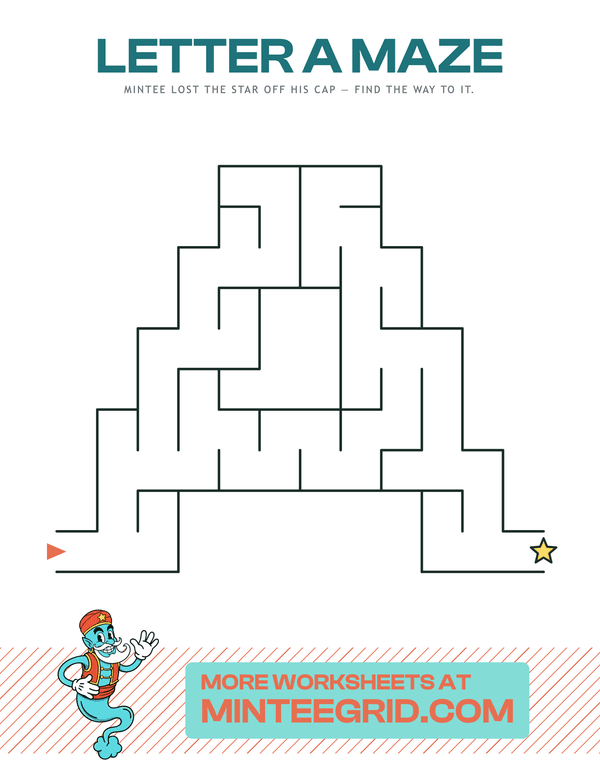
One capital, filling the page. The arrow is on the left edge of the shape, the star is on the right, and exactly one route joins them, running only inside the letter — the corridors stop at the outline, so the shape stays readable from across the room even when it is full of walls.
Pick the letter from the keypad on the form. All twenty-six are there, which sounds obvious until you have looked at a printable pack that covers eight of them and stops.
Which letters, in what order
Not A to Z. Alphabetical order is an ordering of the alphabet, not an ordering of difficulty, and it front-loads two of the harder shapes.
Start with the letters in their own name. These are the letters a child has the strongest reason to know and the most exposure to. If the name is the point rather than any one letter, the name maze puts all of them on one page.
Then the straight-line letters — E, F, H, I, L, T. Every stroke is horizontal or vertical, the shapes are unmistakable at any size, and the maze inside them comes out clean.
Then the mostly-round ones — C, D, O, Q, U. A curve is harder to hold in the head than a corner, and it is harder to draw, which is exactly why it is worth more time.
Then the diagonals — A, K, M, N, V, W, X, Y, Z. These are where letter confusion actually lives. A child who mixes up M and W or N and Z is not being careless; the shapes genuinely are reflections of each other, and spending two minutes traveling inside one of them is a better fix than being corrected.
B, G, J, P, R, S last. Mixed strokes, and S in particular has the tightest waist in the alphabet — at narrow corridors it is the hardest sheet the generator makes.
Choosing the corridor width
| Age | Width | What happens on the page |
|---|---|---|
| 3–4 | Wide | Few junctions. This is a tracing exercise with the letter as the track. |
| 5–6 | Medium | A real maze with dead ends, still finishable in one sitting. |
| 7+ | Narrow | Dense. The letter is still the same size; there is simply four times as much maze inside it. |
The letter fills the page at every setting. Narrow does not give you a smaller letter — it gives you the same letter with more corridors in it, which matters because the shape is the thing you want the child looking at.
Lifehack: print the letter of the week at Wide on Monday and the same letter at Medium on Thursday. Same shape, different puzzle, and the second one is noticeably easier for them than the first was — which is the bit a child notices about themselves.
What this is and is not doing
It is: shape familiarity, sustained attention on one letter, pencil control, and the beginnings of recognizing a letter in an unfamiliar form — because a letter full of maze walls is about as unfamiliar as a letter gets, and being able to still see the E underneath is the actual skill.
It is not: phonics, handwriting, or lowercase. There is no sound in it, the child does not form the strokes, and the mazes are cut into capitals only. Capitals are the right starting point — they are what appears on a peg and a lunch tray, and they are visually the most distinct from each other — but a child who needs lowercase practice needs something else.
For a classroom
Every sheet is generated when it is asked for, so a class of twenty at the same letter and the same width is twenty different mazes. Nobody can copy sideways, nobody has seen theirs before, and the finishing times spread out on their own instead of arriving in a cluster.
That also means the letter of the week is reusable. The same letter next year is a fresh set of puzzles rather than a pack somebody remembers.
Try it yourself
Letter Maze
Any letter of the alphabet, with the maze cut inside it. Mazes · 4+ years.
Related
- A maze made from your child's name — all their letters on one page
- Number mazes for counting practice — the same idea for the digits
- Mazes before handwriting — what a route on paper builds that a pencil drill does not
- Printable mazes by age — where each shape fits
FAQ
What is a letter maze?
A real maze cut into the outline of a single capital letter, filling the page. You pick the letter on a keypad, pick how wide the corridors are, and get one route from the arrow on the left to the star on the right, running inside the shape of that letter.
Which letters should a child do first?
The ones in their own name, then the letters made of straight lines — E, F, H, I, L, T. Curved and diagonal letters are harder to recognize and harder to trace, so they are worth leaving until the straight ones are secure.
Are lowercase letters available?
Not currently — the mazes are cut into capitals. Capitals are what a child recognizes first and what their own name is usually written in on a peg or a tray, so it is the right place to start, but it does mean this is not lowercase practice.
Does a letter maze teach phonics?
No. There is no sound-letter work in it at all. It builds familiarity with the SHAPE of a letter, which is what comes before writing it — the sound has to come from somewhere else.
Is every sheet different?
Yes. The letter is the same shape every time; the maze inside it is generated fresh, so you can print the same letter for a whole class or on five different days and never hand out the same puzzle twice.