Animal mazes that actually look like the animal
September 6, 2026 · 6 min read
There are two ways to make an animal worksheet. One is to print a maze and put a picture of a cat next to it. The other is to make the cat BE the maze.
The second one is the whole point of this sheet, and it is harder than it sounds — which is why the first attempt failed completely.
Why the first version did not work
The obvious plan was to cut the outlines out of artwork we already had: the animals from the I Spy sheets, turned into silhouettes.
At the size a maze grid actually gets — somewhere around thirty cells across — a donkey, a goat and a cow are the same blob on four sticks. So are a duck, a hen and a goose. The detail that tells them apart is in the face and the markings, and a silhouette throws all of it away.
The fix was to stop choosing by species and start choosing by outline. The question is not "which animals do children like", it is "which shapes cannot be mistaken for each other at thirty cells across". That produces a strange-looking list, and a much better sheet.
The fifteen, and what each one is for
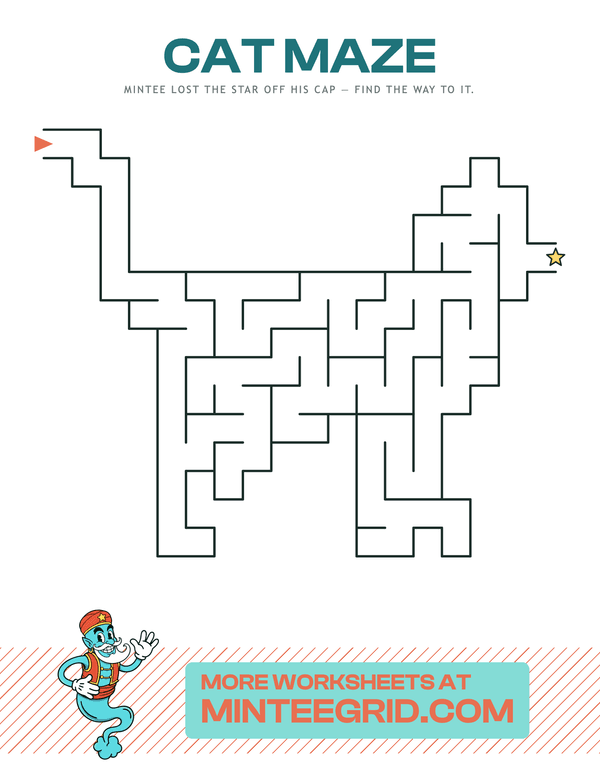
Unmistakable at any size — cat, butterfly, crab, fish, whale, giraffe. These read from across a room. Best for the youngest children, because recognition is instant and there is no "what is it?" before the puzzle starts.
Distinctive profiles — dinosaur, elephant, camel, swan, turtle. A trunk, a hump, a long neck, a shell. Each of these has exactly one feature carrying the identity, which makes them good for a slightly older child who enjoys the moment of working out what it is.
Wings — bat, bird, eagle, owl. The three flying ones are the closest the set comes to overlapping, and even so a bat's scalloped wings, an eagle's spread and an owl's round body are three different things on paper. The owl is the roundest shape in the whole set, which makes it the least interesting silhouette and the best one for holding a lot of maze.
The animal a child is currently obsessed with
Most children go through at least one period of caring about one animal to an unreasonable degree. Sometimes it is the cat asleep on the sofa, which is a specific cat with a name and opinions. Sometimes it is dinosaurs, and it lasts two years and involves a lot of correcting adults about which ones were actually alive at the same time. Sometimes it is whales, or owls, or — for one memorable stretch in most families — crabs.
That obsession is worth spending, because it is the one reliable way to get a child to pick up a sheet they would otherwise walk past. A worksheet about nothing in particular is a worksheet. A worksheet shaped like the thing they are currently an expert on is a different object.
Which is roughly how this list got chosen. The fifteen here are the animals whose outlines are strong enough to survive being cut into corridors — and that overlaps almost exactly with the animals children fixate on, because the reason a child can draw a cat, a dinosaur or a butterfly at four years old is the same reason those shapes work at thirty cells across. They are unmistakable from the outside.
So there is a decent chance your child's animal is already in the list. If it is a cat, a dinosaur, a butterfly, a whale, an elephant or a turtle, it definitely is.
The page is the animal's shape, not a square
This is the only sheet in the family that is not built on a square grid, and it is worth explaining because it changes what you get.
A whale is roughly three times as wide as it is tall. Forced into a square, it would be a whale in a band across the middle with two thirds of the page empty — or, worse, stretched to fill the square, which turns a whale into something that is not a whale. So each animal gets a grid in its own proportions: the whale runs the full width of the page, the giraffe runs the full height.
The practical consequence: a wide animal has a shorter maze in it. A whale gets a broad shallow puzzle; a cat, being closer to square, gets more. If you want the longest solve, pick something square-ish — cat, crab, elephant, turtle.
Choosing the corridor width
| Age | Width | Notes |
|---|---|---|
| 4–6 | Wide | Generous corridors. Stick to the chunky animals — cat, crab, elephant, butterfly. |
| 7–9 | Medium | Every animal works. This is the setting the shapes were tuned for. |
| 10+ | Narrow | Dense. The thin-limbed animals — giraffe, dinosaur, bird — become genuinely fiddly. |
One caveat about the very wide animals. A whale only gets about a third of the page's height to work with, so at the narrowest setting its corridors would come out too thin to draw a line down. Rather than let that happen, the whale gets fewer rows instead — so a whale at Narrow is a little gentler than a cat at Narrow. That is deliberate and it is the right trade.
Lifehack: print two animals with completely different outlines — a whale and a giraffe, say — and put them side by side. Children who have decided all mazes look the same notice immediately that these two are not the same puzzle, and the second one gets attempted on its own merits.
Where these earn their keep
A topic week. Under the sea, minibeasts, dinosaurs, the rainforest. One sheet per child, all on the theme, none of them the same maze.
A child who does not like worksheets but likes animals. This is the specific case the sheet exists for.
Display. Fifteen different animals solved in fifteen different ways is a wall that looks like a class did something.
It will not teach any biology. There is nothing about the animal on the sheet except its shape — no facts, no labels, no habitat. If you want the animal to carry content, the sheet to pair it with is I Spy, where the child counts and records what they find.
Try it yourself
Animal Maze
Fifteen animals, each one a maze cut to its own silhouette. Mazes · 4+ years.
Related
- When square mazes get too easy — where shaped mazes fit in the ladder
- Printable mazes by age — which shape at which age
- I Spy worksheets for early counting — the animal sheet that has content in it
- Printable mazes for a classroom — twenty children, twenty different sheets
FAQ
What is an animal maze?
A real maze cut to the silhouette of an animal, filling the page in the animal's own proportions. The corridors run inside the outline and stop at it, so the shape stays readable — a cat has legs, ears and a tail, and the maze is inside all of them.
Which animals are available?
Fifteen: bat, bird, butterfly, camel, cat, crab, dinosaur, eagle, elephant, fish, giraffe, owl, swan, turtle and whale. They were chosen so that no two are confusable in outline — which is a different list from the fifteen most popular animals.
Is the animal always the same size on the page?
It keeps its own proportions rather than a fixed size. A whale is three times as wide as it is tall and runs the full width of the page; a giraffe is taller than it is wide and runs the full height. Squeezing both into the same square would spend most of the page on nothing.
Which animal is best for a young child?
Cat, fish, butterfly or crab. All four have unmistakable outlines and enough body to hold wide corridors. A giraffe at the widest setting is mostly neck and legs, which makes for a thin maze.