When square mazes get too easy — hexagons and triangles for older kids
September 1, 2026 · 6 min read
There is a point, usually somewhere around eight or nine, where a child stops finding square mazes interesting. The usual response is to print a bigger one, and it does not work: a bigger square maze is a longer version of a puzzle they have already solved. It takes more time and no more thought.
The fix is to change what a cell is.
Six ways out instead of four
On a square grid, standing in a corridor, you came from one direction and there are three others. A wrong turn is one choice in three, and you usually find out within a cell or two.
On a hexagonal grid there are five others, and two of them lead diagonally backwards. A wrong turn is one choice in five, and because two of the options point back the way you came, mistakes take noticeably longer to notice. Error recovery — spotting a dead end and reversing — stops being incidental and becomes most of the exercise.
The second difference is the one people feel before they can name it: there is not one straight corridor on the sheet. A hex grid has no horizontal or vertical lines through it. A passage that looks like it runs across the page is actually stepping up and down as it goes, so a solver cannot skim ahead along a line — which is exactly how most people solve square mazes without noticing they are doing it.
Three ways out, and the ground keeps turning over
A triangular maze looks like it should be the easy one. Three exits, fewer than a square's four. It is not.
The cell flips upside down at every step. An upward-pointing triangle opens left, right and down; the cell you step into is downward-pointing and opens left, right and up. The three directions available are never the same two moves running. A child cannot settle into "keep going right," because what right leads to changes shape underneath them.
There is a second thing about triangular grids worth knowing, because it explains why our triangle mazes have visibly narrower corridors than the others. A triangle has three neighbors where a hexagon has six, so there are half as many walls in the grid to begin with — and carving a maze still has to open the same number of connections. The result is that two thirds of the walls come down on a triangular grid against one third on a hexagonal one. At the same cell size it reads as open rooms rather than corridors, so the cells have to be smaller to read as a maze at all.
Lifehack: hand a child who is bored of square mazes the hexagon at medium rather than narrow. The novelty of the geometry is doing the work; adding a hard corridor width on top usually turns "this is interesting" into "this is annoying" on the first sheet.
Which of the two first
Triangle first, around six. It is the smaller jump — the sheet still reads left to right, and the difficulty is in the constantly-changing choice rather than in a bigger fan of options.
Hexagon around seven, and it is the ceiling. Nothing else we make is harder. A child who works through a narrow hexagon maze without slowing down has finished this ladder, and the useful next step is a puzzle with subject matter in it rather than a harder shape.
Both take two mazes to a page, and both shift their corridor widths when they do, for the same reason every generator here does: half the area at the same corridor width is half the cells, and a "medium" that lands where a one-up "easy" lands is a label that lies.
Try it yourself
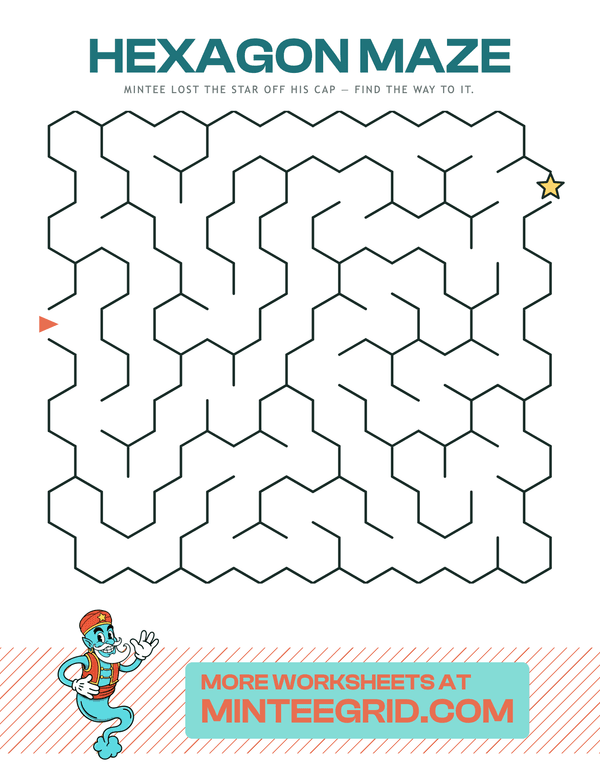
Hexagon Maze
Six ways out of every cell, and not one straight corridor. Mazes · 7+ years.
When to stop reaching for mazes
Worth saying plainly, since we make them: a maze has no subject in it. No arithmetic, no letters, no facts. It practices planning, memory, error recovery and pencil control, and it does those well, but it will not teach a nine-year-old anything they need for school.
Once the geometry has run out, the honest move is sideways rather than up — to Crack the Code at a higher number range, or long multiplication if the arithmetic is the thing that needs the practice. The "keep going, you're getting somewhere" feeling is the same; there is just something underneath it.
Related
- Printable mazes by age — the whole ladder in one place
- Circular mazes vs square ones — the other way to change the problem instead of the size
- How hard should a maze be? — why shrinking a maze is the wrong dial
FAQ
Are hexagonal mazes really harder than square ones?
Yes, and for two separate reasons. Six ways out of every cell means a wrong turn is one choice in five rather than one in three. And there is not one straight corridor on the sheet — a passage that looks like it runs across the page is actually zig-zagging — so the usual trick of scanning ahead down a line does not work. It is the hardest sheet on the site at any given corridor width.
Why is a triangular maze hard when a triangle has fewer sides?
Because the cell flips over at every step. Three exits sounds easier than four, but the three on offer are never the same two moves running — an upward triangle opens left, right and down, and the cell you move into opens left, right and up. A child cannot settle into a strategy like "keep to the right," because what "right" leads to keeps changing.
What age are these for?
Triangle from about six, hexagon from about seven. Those floors are higher than the classic maze's because neither shape has a setting as forgiving as the classic's widest — they are built for the end of the ladder rather than the start of it.
Is there anything harder than a hexagon maze?
Not on the site today. If a child is walking through hexagon mazes at the narrow setting, the honest next step is not another maze — it is a puzzle with content in it, like a Crack the Code sheet at a higher number range, where the difficulty comes from the arithmetic rather than from the geometry.