Circular mazes vs square ones — why the round one often lands better
August 26, 2026 · 6 min read
Bend a rectangular maze into a ring and you have not made a circular maze — you have made a rectangular maze that is awkward to draw. A real polar maze is built differently, and the difference is not cosmetic. It changes who can solve it.
The one thing that matters: the goal is in sight
On a rectangular maze the exit is somewhere off to the right. Halfway across, a child can genuinely lose track of whether they are making progress — the walls all look the same and there is no landmark. That flat "I don't know where I am" moment is a real part of the difficulty, and it is a part nobody chose to put there.
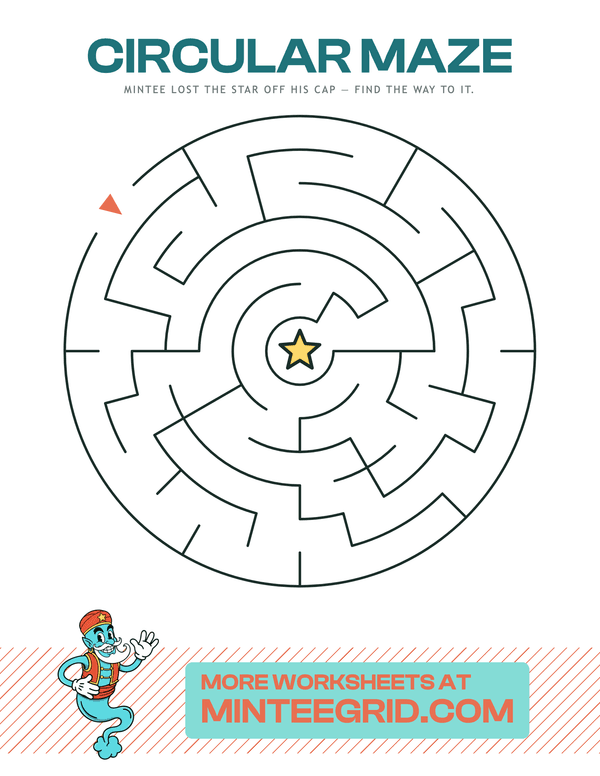
On a circular maze the finish is the middle of the page, visible from the second the sheet lands on the table. Every step is either closer to it or not, and a child can tell which without being told. All the route-finding is still there — every dead end, every wrong branch — but the disorientation is gone.
That is why we would hand a circular maze to a four-year-old before a rectangular one of the same size. Not because it asks less, but because it asks fewer different things at once.
How the grid actually works
A polar grid has a problem a square grid does not: a ring near the rim is several times longer than a ring near the middle. Divide every ring into the same number of cells and the outer ones become enormous while the inner ones become slivers.
So rings split. As they grow, a ring divides in two, and then in two again, so a cell stays roughly square no matter how far out it sits. On a sheet with thirteen rings you might get 1, 6, 12, 12, 24, 24, 24, 48… cells, each division happening at the point where cells would otherwise start looking stretched.
This has a nice side effect for difficulty. How eagerly rings split is a second dial: split them sooner and you get more sectors, more junctions and more maze at the same corridor width. That is how the hardest circular setting gets harder without asking anything more of the pencil — it gains junctions rather than just gaining rings.
What it costs
Honesty about the trade: a circle on a portrait page wastes the corners. A rectangular maze fills the sheet edge to edge, and a circle inscribed in the same space uses about 79% of it. That is real paper.
Four circles on a page recover most of it, which is why that layout exists and why two does not — two circles in half-page slots leave the corners of both slots empty, so two wastes more than four does.
Lifehack: the four-up circular sheet is the one to print for a car journey or a waiting room. Four short puzzles with four separate finishes hold a five-year-old for far longer than one long one, and there is no page-turning involved.
Which to reach for
- Circular — a child who gets disoriented halfway across a rectangular maze; a first "real" maze after wide-corridor practice; anything where finishing matters more than duration.
- Classic rectangular — the widest corridors on the site, so still the right first maze at three; and the most cells per sheet at the hard end, so still the longest single puzzle.
- Hexagon or triangle — once neither of the above is slowing the child down.
Both mazes end the same way, incidentally: Mintee has lost the star off his cap and it is at the far end. On the circular one the far end is the middle, which is the whole point.
Try it yourself
Circular Maze
Rings and radial corridors — work your way in to the middle. Mazes · 4+ years.
Related
- Printable mazes by age — where the circular one sits in the ladder
- How hard should a maze be? — corridor width versus turns
- What a maze actually teaches — why the "goal in sight" difference matters more than it sounds
FAQ
Is a circular maze easier or harder than a square one?
At the same number of cells it usually feels easier to a young child, and it is not because the puzzle is smaller. The goal is the middle, so it is in sight the whole time and there is never any doubt about which direction counts as progress. A rectangular maze quietly adds that doubt, and for a four- or five-year-old it is a real part of the difficulty.
Why do the rings have different numbers of cells?
Because a ring near the rim is much longer than a ring near the middle. If every ring were divided the same way, the outer cells would be enormous and the inner ones would be slivers. Rings split in two as they grow, so a cell stays roughly square wherever it sits — which is what stops the maze from loosening as it gets further out.
Can you get four circular mazes on one page?
Yes, and it is a genuinely different product rather than the same sheet shrunk. Four circles get their own corridor widths so a hard four-up is properly hard, and finishing something four times in a sitting is worth more to a five-year-old than finishing something once.
Is a circular maze the same as a labyrinth?
No, though the words get used interchangeably. A classical labyrinth has one winding path with no junctions at all — you cannot get it wrong, and walking it is the point. A circular maze has real branches and dead ends. If you want the labyrinth feeling, the closest thing here is a wide-corridor maze, where there are few enough junctions that it reads as a journey rather than a test.