Heart mazes for Valentine's Day — thirty children, thirty different hearts
September 6, 2026 · 5 min read
Every February the same thing happens. A teacher searches for Valentine's worksheets, finds a pack, prints thirty copies, and hands out thirty identical pages. By the second row somebody has copied somebody, and by the end of the week the pack is on a shelf until next year, when it will be exactly as identical as it was this time.
The problem is not the theme. It is that a pack is a fixed set of pages, and a class is thirty different children on one particular afternoon.
What is different here
The heart is the same shape every time. The maze inside it is built when you ask for it.
That single fact removes the whole cluster of February problems at once: nobody can copy sideways because their neighbor's route is not their route, nobody has seen theirs before, the finishers stop arriving all at the same moment, and next year's class gets a genuinely fresh set from the same settings.
The heart is a real outline, not a border
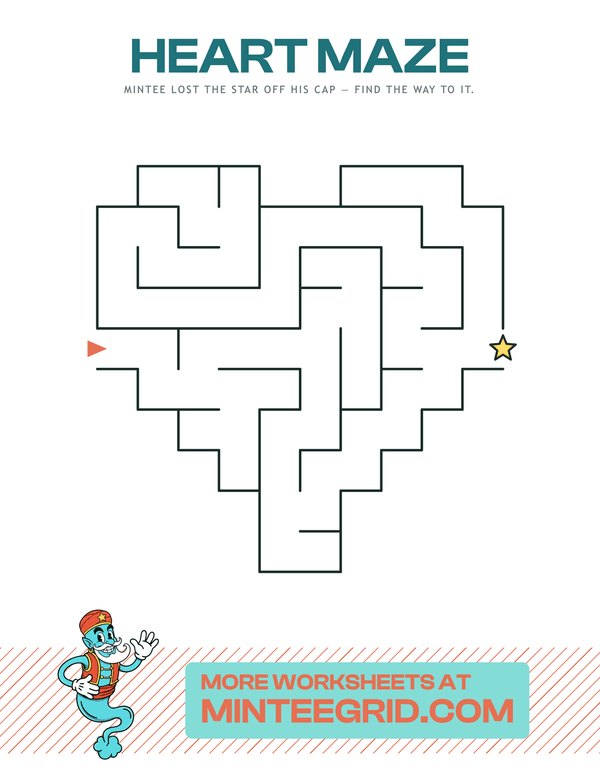
Worth saying because plenty of "shaped" worksheets are not. The corridors are cut to the heart and stop at it — there is no rectangle hiding behind the shape and no dead space in the corners. Every corridor on the page is inside the heart, right up into the two lobes and down to the point.
Getting the notch between the lobes to survive took two attempts. The textbook implicit heart curve has a cleft too shallow to draw on a grid: at nineteen cells across, the dip between the lobes came out one cell deep and the shape read as a blob. The heart here is built from two circles and a V instead, which puts the notch a fifth of the way down the page where it is unmistakable.
Choosing a width for February
| Age | Width | What it is |
|---|---|---|
| 5–6 | Wide | Five to ten minutes. Good for a card front. |
| 7–8 | Medium | A real puzzle, fills a settling slot properly. |
| 9+ | Narrow | Dense. Keep a few for the early finishers. |
The heart stays the same size on the page at every setting, so a harder sheet is a denser heart rather than a smaller one — it still reads as a heart from the back of the room.
Lifehack: print the batch one width wider than you think the room needs, and keep five at the next width down in a drawer. The children who finish in three minutes are the reason February activities go wrong, and five spare sheets fixes it without a second print run.
Three things to do with them
A card front. Widest setting, cut round the outline, glue to folded card. The child solves it, then gives away something they made and completed.
A settling activity for the week. Not the fourteenth alone — the whole week tends to be unsettled, and a five-minute sheet that needs no explanation is worth having on hand for all of it.
A display. Thirty solved hearts, each with a different red pencil line through it, is a wall that took one print run.
What it is not
It is not a lesson. There is no arithmetic, no letters, and nothing on a curriculum in a heart maze — it is a settling activity, an early-finisher task, or a card. If you want something with the same February look and actual content underneath, Crack the Code does arithmetic with a decoding shape to it.
And if you want the shape without the season, the star and diamond mazes are the same engine with no date attached.
Try it yourself
Heart Maze
A heart-shaped maze — the one to print in the first week of February. Mazes · 5+ years.
Related
- Printable mazes for a classroom — the full case for thirty different sheets
- When square mazes get too easy — where shaped mazes sit
- Printing tips for crisp sheets — a class set out of one cartridge
- How hard should a maze be? — one setting for a room full of different hands
FAQ
What is a heart maze?
A real maze cut into the outline of a heart, filling the page. One route runs from the arrow on the left to the star on the right, staying inside the shape the whole way.
Can I print a different heart for every child?
Yes, and that is the default rather than an option. Nothing is pre-drawn, so a batch of thirty at the same settings is thirty different mazes inside the same heart.
What age is it for?
Five and up. At the widest corridors it is a settling activity for a five-year-old; at the narrowest it will occupy a nine-year-old properly. The heart is the same size at every setting.
Can the maze go on a card?
Yes — print at the widest setting, cut round the heart, and glue it to the front. A solved maze on the front of a card is a better object than a sticker, and the child made both halves of it.