Beating the summer slide in five minutes a day
October 20, 2026 · 6 min read
Ten weeks of summer is long enough for skills to go rusty — especially math facts, which children do not meet much outside school. The fix is not summer school. It is a few minutes a day.
The plan: little and often
- Reading: 15–20 minutes a day, any book they choose.
- Math: 5–10 minutes a day, one sheet or one game.
- Skip weekends if you like. Five days a week is plenty.
Lifehack: attach it to something that already happens — the first thing after breakfast, before screens. A habit tied to a habit sticks.
What to practice, by grade going into
- Kindergarten: counting objects, colors, shapes, big and small — Count and Graph, Circle the Color.
- First grade: adding and subtracting to 10, telling time to the hour — Telling Time, Number Bonds.
- Second grade: facts to 20, place value, time to five minutes — Place Value, A.M. or P.M.?.
- Third grade: multiplication facts, elapsed time — Multiplication, Telling Time on the elapsed-time setting.
- Fourth grade: multiplication and division facts, long division — Long Division.
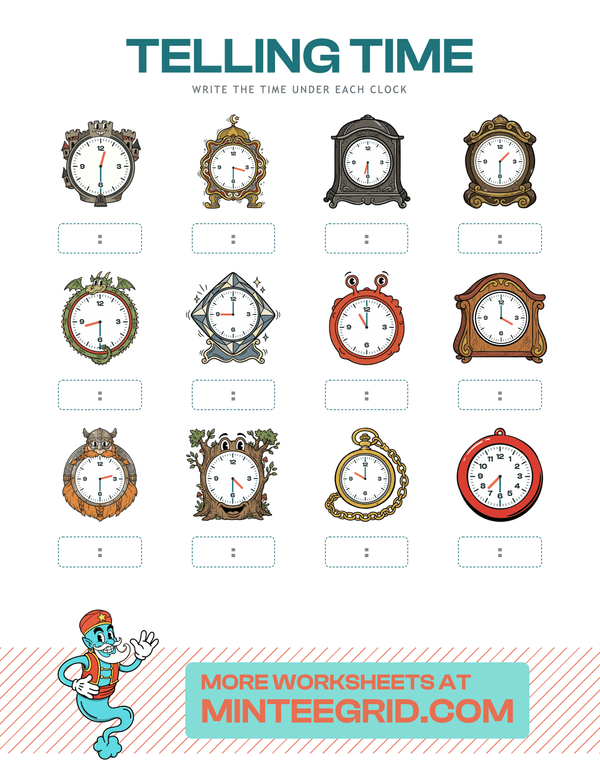
Try it yourself
Telling Time
Read the clock, draw the hands, match, time in words, elapsed time — on themed clocks. Math · 6–9 years.
Keep it light
Summer practice works when it does not feel like school. Let your child pick the sheet, the picture or the theme, stop while it is fun, and mix in games. See math fact fluency in five minutes a day for the routine.
FAQ
What is the summer slide?
The loss of reading and math skills over the summer break. Studies differ on how much, but many children start the new school year behind where they ended the last, especially in math.
How do I prevent the summer slide?
Keep reading every day, and practice math a few minutes a day — facts, a worksheet, a game. Little and often beats a big push at the end of August.
How much practice is enough over the summer?
Around 10 to 20 minutes of reading and 5 to 10 minutes of math most days is plenty for most elementary school children.