Back-to-school printables for the first weeks — what to print, and when
September 6, 2026 · 7 min read
The first two weeks of a school year are not really about learning anything. They are about thirty children who mostly do not know each other, in a room they do not know, with an adult they have just met, all of whom are more tired than they will admit.
Sheets are genuinely useful in that fortnight, but the useful ones are a different set from the ones that are useful in November. Here is what each one is actually for.
Day one: something with their name on it
The single best first-morning sheet is one carrying the child's own name, because on that particular morning nothing else in the room does. Not the peg, not the tray, not the chair — those get labeled during the day, and the sheet arrives already theirs.
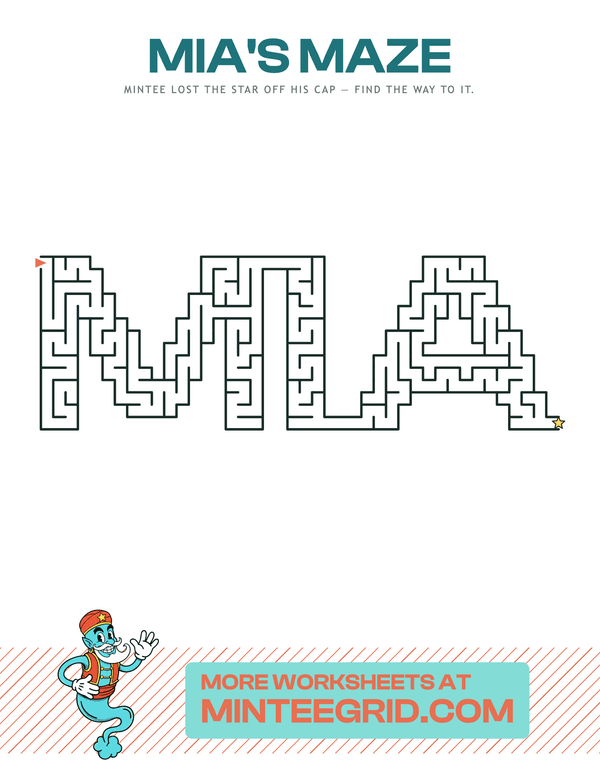
A name maze puts the child's name across the page in capitals with a maze cut into the letters, so it is a real activity rather than a decorated label. Making one per child takes about twelve minutes for a class of twenty-five; there is a separate guide to doing the whole class with the workflow, the cost and the awkward parts about hyphens and accents.
It also does something useful that nobody has to mention: it tells you, on day one, which children recognize their own name in capitals and which do not.
The first week: sheets that need no instructions
An anxious child in a new room will not ask what to do. They will sit and wait, or copy their neighbor, or do nothing and hope it passes.
So the criterion for a settling sheet in week one is not the difficulty — it is whether it can be started without asking anybody anything. A maze qualifies completely: there is an arrow at one end, a star at the other, no reading, and no way to misunderstand the task.
Print wide. The first week is not the moment to find out where anyone's ceiling is.
Good candidates:
- Classic maze at the widest setting, one per child, all different
- Animal mazes — the shape gets the sheet picked up before the child has decided how they feel about worksheets
- Two mazes to a page for a short settling slot, which gives two finishes instead of one
Weeks two and three: finding out where everyone is
Once the room has calmed down, sheets stop being a settling device and start being useful for something else: working out, quietly, what each child can actually do.
A maze is a surprisingly good instrument for this because it isolates one thing. It has no content in it — no reading, no arithmetic, nothing anyone could have been taught over the summer — so what it shows is pencil control, persistence, and whether a child can hold a plan while carrying it out. Those are exactly the things you want to know in week two and exactly the things that are invisible in a written assessment.
Hand out the same width to the whole room and watch. The children who finish in two minutes and the ones still going at ten are telling you something, and it is not about ability with mazes.
The early-finisher problem
Every first fortnight has the same failure: identical sheets produce a cluster of "I'm finished" at the same moment, and the room comes apart.
Two things fix it, and neither is complicated.
Different sheets. Nothing here is pre-drawn, so a batch of thirty at one setting is thirty different mazes — same difficulty, same rough solving time, different route. Finishing times spread out on their own.
A drawer of narrower ones. Print five at the next width down and keep them out of sight. When somebody finishes early, they get something genuinely harder rather than more of what they have already proved they can do.
Lifehack: print the whole first fortnight in one session at the end of August — a wide batch for settling, a narrow batch for early finishers, and the name mazes. It is one trip to the printer instead of five, and the second week of term is the worst possible time to discover the toner is out.
For parents, not teachers
If your child has just started school, the useful thing to print at home in September is less than you think, and not academic.
The first weeks are physically exhausting in a way that surprises everybody. A child who has held it together all day has nothing left at four o'clock, and a worksheet at that hour is a fight you will win and regret.
What does work: something short, on a weekend morning, chosen by them. A wide maze is pencil-control practice that does not feel like practice, which is genuinely useful in reception year — see mazes before handwriting for why the route comes before the letter strokes.
And keep one folder of sheets in the car for the school run, because September is also the month of unexpected waiting: worksheets for waiting rooms and long journeys.
Try it yourself
Name Maze
Type a name and get one maze that runs through every letter of it. Mazes · 4+ years.
Related
- Name mazes for a whole class — twenty-five children, twenty-five names
- Printable mazes for a classroom — why thirty different sheets beats thirty copies
- Mazes before handwriting — what a route on paper builds
- How long should a child work on a worksheet? — the attention a tired child actually has
FAQ
What should I print for the first day of school?
Something with each child's own name on it. A name maze gives every child a sheet that is unmistakably theirs on a morning when nothing else in the room is, and it quietly shows you who can already recognize their name in capitals.
What are good settling activities for the first week?
Anything that needs no instruction and cannot be got wrong quickly. Wide-corridor mazes qualify: the arrow says where to start, there is no reading involved, and a child who is anxious about a new room can do one without asking anybody anything.
How do I stop children copying each other's sheets?
Give them different sheets. Every maze here is generated when it is requested, so a batch of thirty at the same settings is thirty different puzzles — copying gets you a wrong answer rather than a right one.
What should I print for a child starting school at home?
Pencil-control work rather than academic work. A wide maze is a pre-writing exercise dressed as a game, and the first weeks of school are physically tiring enough without adding content at home.