Spiral mazes — you can see the whole thing and still not know the way
September 6, 2026 · 6 min read
Most mazes hide themselves. The corridors go off in four directions and you cannot hold the whole thing in your head, which is exactly why a child has to work through it rather than look at it.
A spiral does the opposite. The whole puzzle is visible from the doorway — one coil, wound in from the outside to a star in the middle, and you can see every millimeter of it before you pick up a pencil. It should be trivial.
It is not, and the reason is worth a minute.
What makes it a maze
If the coil were unbroken, this would be a tracing sheet: one path, no choices, in at the edge and out at the center. Lovely for a three-year-old and not a puzzle.
So the coil is cut. Doors are opened between one winding and the next, and every time a door goes in, a step of the corridor is closed somewhere else. The result is that following the spiral round patiently will, sooner or later, walk you into a wall — and the way on is to cut across to the winding beside you, sometimes inward, sometimes back out.
That is the feeling this shape has and no other maze does: you can see the whole thing, and it still beats you. Children who are put off by a wall of corridors will pick this one up because it looks approachable, and then have to think anyway.

Not the circular maze
These two get confused constantly, including by us — the first two attempts at building this one came out indistinguishable from the circular maze and were thrown away.
A circular maze is a set of concentric rings with radial gaps punched between them. The route crosses from ring to ring in many places, and what it reads as is a wheel: you are working across a structure.
A spiral is one corridor. It has a beginning and an end and a direction, and what it reads as is a journey: you are going somewhere, and the middle is the destination. Same family, entirely different feeling in the hand.
Choosing the corridor width
| Age | Width | What is on the page |
|---|---|---|
| 5–6 | Wide | Few windings, about ten doors. The coil is unmistakable and the puzzle is short. |
| 7–9 | Medium | More windings, twenty-six doors, real dead ends. |
| 10+ | Narrow | Dense coil, fifty-plus doors. Reads almost like a labyrinth from a distance. |
Wider corridors do not just mean a fatter line — they mean fewer windings on the page and fewer places where the route can break through. Narrow gives you both more coil and more doors, which is why the jump from medium to narrow is bigger here than on an ordinary maze.
Where the shape comes from
Spirals are one of the few genuinely universal shapes. A snail shell is one. So is a fern before it opens, a whirlpool, a galaxy, the way a cat sleeps and the way a rope coils when you drop it. Children recognize the shape long before they can name it, which is part of why this sheet gets picked up off a table.
That is also the pitch to a child who says they do not like mazes: this one is a shell, and the star is inside it.
Lifehack: give a spiral to a child who has decided mazes are too hard. The visible whole is genuinely reassuring, the wide setting is generous, and finishing one tends to reset the opinion faster than an easier rectangular maze does — because it looks like it should have been difficult.
What it teaches
Same as any maze: route planning, holding a plan while executing it, recognizing a dead end and going back. The one thing it does slightly better than the others is backtracking without distress. On a rectangular maze a dead end feels like a mistake; on a spiral, reversing to the last door is so obviously part of the shape that children do it without the sense of having gone wrong. That is a small thing and it matters for the ones who give up easily.
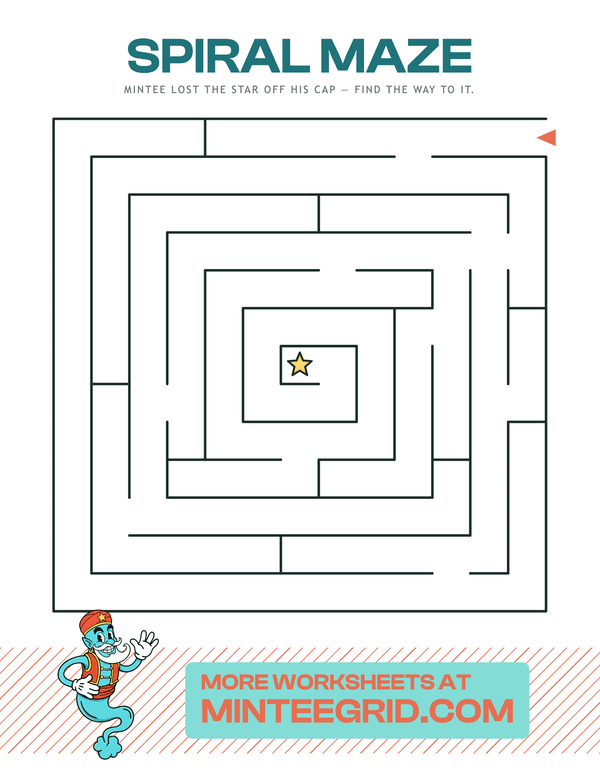
Try it yourself
Spiral Maze
One coil wound in to the middle, with ways through to the next. Mazes · 5+ years.
Related
- Circular mazes vs square ones — the shape this one is constantly mistaken for
- When square mazes get too easy — where to go next
- Printable mazes by age — the whole ladder
- How hard should a maze be? — reading the hand, not the age
FAQ
What is a spiral maze?
A single corridor wound in from the outside edge to the middle, with doors cut between one winding and the next. Following the coil round will not get you to the center — the doors open some routes and close others, and exactly one path reaches the star in the middle.
How is it different from a circular maze?
A circular maze is rings joined by radial passages, so the route crosses between rings in many places and reads as a wheel. A spiral is one continuous coil, so it reads as a journey inward. They look related and they solve nothing alike.
What age is a spiral maze for?
Five and up at the widest corridors, where the coil is clear and there are only a handful of doors. Older children get more out of the narrow setting, where there are five times as many places the route can cut through to the next winding.
Where is the finish?
Dead center, always — that is what makes this shape work as a picture. The start is at the outer corner, and the star Mintee lost off his cap is waiting in the middle cell.