Star and diamond mazes — shape of the week, without the shape worksheet
September 6, 2026 · 6 min read
The standard shape worksheet asks a child to color in a star, trace a dotted star, and circle the star among four shapes. It takes about ninety seconds and most of that is choosing a crayon.
The thing a child is supposed to take away is what a star's outline does — five points, five inner corners, the way the angles alternate. Coloring in does not put any attention on that. Traveling around the inside of it for four minutes does.
What is on the sheet
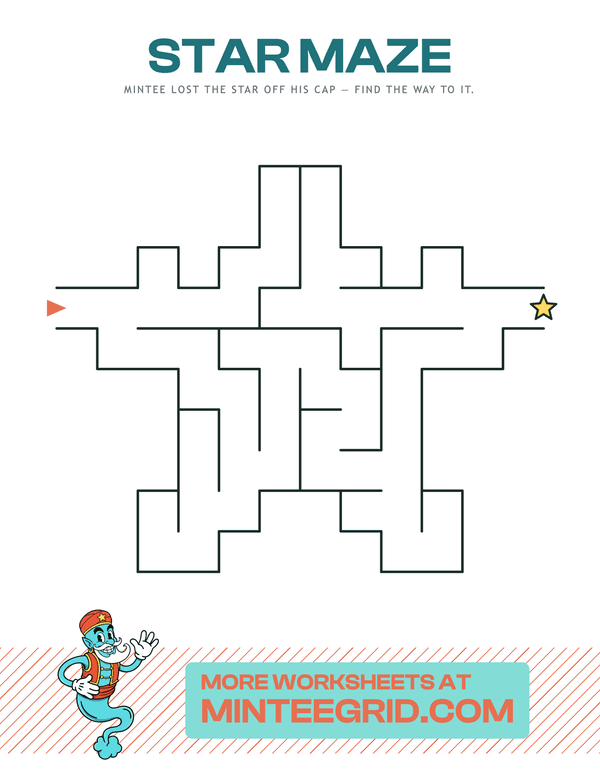
One shape, filling the page, with a real maze cut into it. The corridors stop at the outline, so the star stays a star. The arrow is on the left edge of the shape, the star Mintee lost off his cap is on the right, and exactly one route joins them.
Two shapes here, and they do genuinely different jobs.
The star: five points to get lost in
The star maze is the one children pick up. A five-pointed star is probably the first shape a child learns to draw that is not a circle, square or triangle, and it is the first one that is actually difficult — the alternating in-and-out is a real thing to hold in the head.
On the sheet, each of the five points is a cul-de-sac with one way in. That is not a design choice, it is what a point is, and it makes the star an unusually honest maze: the shape itself tells you where the dead ends are, and a child who notices that has learned something about stars rather than about mazes.
The diamond: the maze with no edge to follow
The diamond maze exists for one reason, and it is not decoration.
On any rectangular maze there is a shortcut that has nothing to do with solving it: put a finger on the border and run it round. Plenty of children discover this and it quietly ends the exercise. Turn the square onto its corner and the border slopes away in two directions at once — there is no straight edge to follow, and the shortcut disappears.
What it does not do is make the puzzle harder to think about. The corridors inside still run up, down and across, exactly like the classic maze, because it is the outline that is turned rather than the grid. So a diamond is a good first step away from the rectangle: it looks completely different and it demands nothing new.
Shape of the week, three sheets deep
| Week | Sheet | The thing being learned |
|---|---|---|
| Star | Star maze | Points and inner corners alternate; a point is a dead end |
| Diamond | Diamond maze | A square is still a square when you turn it |
| Heart | Heart maze | A shape can have a notch in it |
For letters and numbers the same idea runs through the letter maze and the number maze — one glyph a week, filling the page.
Lifehack: print the diamond and the classic maze at the same corridor width and hand them out together without saying anything. Children who have been running a finger round the border of every maze will visibly stall on the diamond, and that is the moment to talk about it. Telling them beforehand does not land in the same way.
Choosing a width
| Age | Width | Notes |
|---|---|---|
| 5–6 | Wide | Generous. The shape is enormous and the puzzle is short. |
| 7–8 | Medium | The setting these were tuned at. |
| 9+ | Narrow | Dense. A star at narrow has real depth in each point. |
The outline is the same size at every setting. A harder sheet has more corridors in the same star, not a smaller star — which matters when the whole point is that the child is looking at the shape.
What this is not
It is not geometry. There is no vocabulary on the sheet, no vertices counted, no angles named. What it gives is time spent inside a shape, which is the thing a five-year-old needs before any of that language means anything. The naming has to come from you.
Try it yourself
Star Maze
A maze cut into the shape of a star, with five points to get lost in. Mazes · 5+ years.
Related
- Heart mazes for Valentine's Day — the seasonal member of the same family
- Alphabet mazes for letter recognition — the same idea, A to Z
- When square mazes get too easy — where to go after the classic
- Printable mazes by age — the full ladder
FAQ
What is a shaped maze?
A real maze with an outline cut out of it — a star, a heart, a diamond — rather than a rectangle with a shape drawn beside it. The corridors run inside the outline and stop at it, so the shape is readable from across the room even when it is full of walls.
Is a diamond just a square turned round?
Geometrically yes, and that turn is the whole point. The corridors inside still run up, down and across, but the outline now slopes away in both directions, which removes the easiest way to cheat at a maze: running a finger along the border.
Does the shape get smaller at harder settings?
No. The outline is the same size on the page at every corridor width — a hard sheet is a denser star, not a smaller one, so it still reads as a star at the narrowest setting.
What age are these for?
Five and up. The floor is a little higher than the classic maze because a shape has to keep enough cells to still read as the shape, so the corridors cannot go quite as wide as the classic's widest setting.