Where worksheets fit in a week — and the four times they do not
September 6, 2026 · 7 min read
Most worksheets that fail were fine. They were handed over at the wrong moment, to a child who had nothing left, and then everybody concluded something about worksheets.
Timing is doing more work here than difficulty, theme, or anything else you can choose on a form. It is also the only variable most parents never adjust.
The four times it will not work
Straight after school. The single most common mistake. A child who has held it together for six hours in a room full of other people is running on nothing by four o'clock, and the fact that they seem fine is a poor guide — that is the last of it being spent on getting home. Anything academic in the first hour after school is a fight you can win and will regret.
Before dinner. Hunger looks exactly like defiance from the outside and is not remotely the same thing. Food first, every time.
As a consequence. "You can go out when you've finished this." It works once. What it teaches is that the sheet is the price of something better, which is a durable lesson and precisely the wrong one.
When you have somewhere to be. A child can feel the clock. Anything done under time pressure gets rushed and finished badly, and a badly finished sheet is worse than no sheet, because it establishes that this is a thing to get through.

The four that do
Saturday or Sunday morning. The best slot there is. Rested, fed, no clock, and — importantly — nothing has yet happened to be in a bad mood about. Fifteen minutes here is worth an hour anywhere else in the week.
After a snack, any day. Attention tracks blood sugar closely enough that a snack is functionally a difficulty adjustment. The same sheet is measurably easier twenty minutes after eating.
While something is cooking. Twenty minutes with an adult in the room, occupied but present, is a very good shape for this. The child is not being supervised, which removes the observation problem, and there is a natural ending that nobody has to negotiate.
In dead time you did not choose. Waiting rooms, delayed trains, the hour before a flight. This is the slot where a worksheet is unambiguously a rescue rather than an imposition — worksheets for waiting rooms and long journeys covers what to put in the folder.
Two or three times a week, not daily
Daily practice is a schedule that suits adults. It is not a requirement for anything a child does outside school, and it has a specific failure mode: it turns into an obligation, obligations get resented, and resentment outlives the habit.
Two or three short sessions a week is genuinely enough for the things a maze or a code sheet builds. It also leaves room to skip a week when the week is bad, without the skipping meaning anything.
| Rhythm | What it is good for |
|---|---|
| One weekend morning | The default. Fifteen to twenty minutes, unhurried. |
| One weekday, after a snack | Ten minutes, something short and finishable. |
| A folder in the car | Not scheduled. Used when dead time appears. |
| A fortnight off | Fine. Nothing is lost and willingness recovers. |
Attach it to something that already happens
The routines that survive are the ones bolted onto an existing event. "After breakfast on Saturday" works because breakfast on Saturday already reliably happens. "Twenty minutes of practice a day" does not work, because it needs a slot carved out of a day that was already full, and the carving is the part that stops.
This is why "print a batch on Sunday for the week" beats "print something when we need it". The decision has already been made at the moment it is needed, and nobody has to have the conversation.
The sibling version
With two children the timing problem doubles, because their good hours are not the same hours — a six-year-old and a nine-year-old genuinely have different tiredness curves, and the older one is fine at a time when the younger one is finished for the day.
Two options, both fine. Run them at different times and stop treating it as a shared activity. Or run them together in the younger child's good window, which means the older one is working below their peak — perfectly acceptable, since the point of that session is that it happens at all. There is more on the seating arrangements in worksheets for siblings at different levels.
Lifehack: try the sheet your child refused on a Saturday morning, without mentioning that it is the same one. It very often just gets done. That tells you the refusal was about Tuesday at five, which is worth knowing before you change anything about what you print.
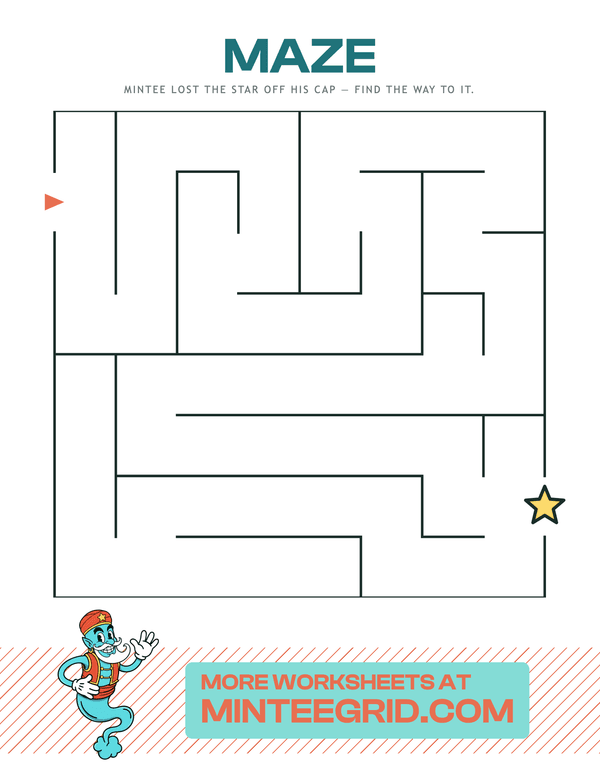
Try it yourself
Classic Maze
One way in, one way out — and never the same maze twice. Mazes · 3+ years.
Related
- How long should a child work on a worksheet? — how much attention there is to spend
- Too easy or too hard — reading which failure you have
- Worksheets for siblings at different levels — two children, one table
- Why worksheets beat screens for practice — the case for paper
FAQ
When is the best time of day for a child to do a worksheet?
Morning, or straight after a snack. Attention is a physical resource and it tracks blood sugar and tiredness far more than it tracks interest — the same sheet that works at ten on a Saturday is a fight at five on a Tuesday.
How often should a child do worksheets?
Two or three short sessions a week is more than enough for anything outside school, and it beats one long session for both retention and willingness. Daily is a schedule for adults, not a requirement for children.
Should worksheets be part of a routine or done spontaneously?
A routine, but a small one attached to something that already happens — after breakfast on a Saturday, or while dinner is in the oven. Routines that need their own slot in the day get skipped within a fortnight.
My child refuses worksheets entirely. What now?
Check the timing before the content. A refusal at five in the afternoon is a tiredness signal, not an opinion about worksheets — try the identical sheet on a weekend morning before concluding anything.