Too easy or too hard — reading which one you have, before the child tells you
September 6, 2026 · 6 min read
A child stops working. From the other side of the room the picture is identical whether the sheet was too hard or too easy — same sigh, same putting the pencil down, sometimes the same word: boring.
The two problems need opposite fixes, so guessing wrong makes it worse in both directions. Luckily they are easy to tell apart if you know where to look, and the tell is when they stopped rather than what they said.
Too hard stops early
Difficulty failures happen in the first minute, before anything has really started.
The signs are specific. They pick up the pencil and put it down again. They ask for help without being able to say what about. They ask whether they have to. They start at the wrong end. They go very quiet — this is the one people miss, because a quiet child looks like a working child for a while.
The common thread is that nothing has been produced. A too-hard sheet is usually almost blank when it is abandoned.
Too easy stops at the end
Boredom failures happen after completion, not before it.
The sheet is finished, quickly, correctly. There is no pride in it and no interest in showing you. Asked if they want another, they say no. If they do carry on, the pencil work gets decorative — borders, faces on things, a name written enormously.
The common thread: the work is done and nothing came of it. A too-easy sheet is finished and discarded.
| Too hard | Too easy | |
|---|---|---|
| When it stops | First minute | After finishing |
| The page | Mostly blank | Complete and correct |
| What they say | "Boring" or "help" | "Boring" or nothing |
| Body | Still, quiet, slumped | Restless, wants to leave |
| Next sheet | Refused | Shrugged at |
Note that "boring" appears in both columns. It is the least informative word a child can produce and it is the one they use most, because it is the only description of a bad experience that costs nothing socially. Never take it as evidence of anything except that something went wrong.
The fixes are not the same size
Too hard — go one step wider and try again the same week. Do not go two steps; a sheet that is obviously beneath them is its own kind of message. And do not swap in a different activity, because that teaches that difficulty is escapable rather than adjustable.
Too easy — do not just narrow the corridors. A harder version of the same sheet is more of what they already found dull. Change the shape instead: a hexagon maze has six ways out of every cell rather than four, and a spiral is visible in its entirety and still difficult. Those are new problems, not longer ones. There is more on that in when square mazes get too easy.
Err downward
The two mistakes are not equally expensive, and this is the single most useful thing to know here.
A child given something slightly too simple finishes it, feels fine, and does another. The cost of that error is a few minutes.
A child given something slightly too hard stops, feels bad about it, and is measurably less likely to pick up the next sheet you offer — not the next one of that kind, the next one at all. The cost of that error is measured in weeks of willingness.
So when you genuinely cannot tell: go easier. You can always narrow it next time, and there will be a next time, which is exactly what you lose by going the other way.
Lifehack: print two widths and let the child choose. It costs one extra sheet and it removes the guess entirely — children pick their own level with startling accuracy when nobody is watching them do it, and the choosing itself buys attention.
The third possibility
Sometimes it is neither. A child who is hungry, over-tired, or was in the middle of something else will fail a perfectly-pitched sheet, and no adjustment to the difficulty will do anything about it.
The test is to offer the same sheet at a different time of day. If it goes fine, the problem was never the worksheet — and the useful conclusion is about when you sit down rather than what you print.
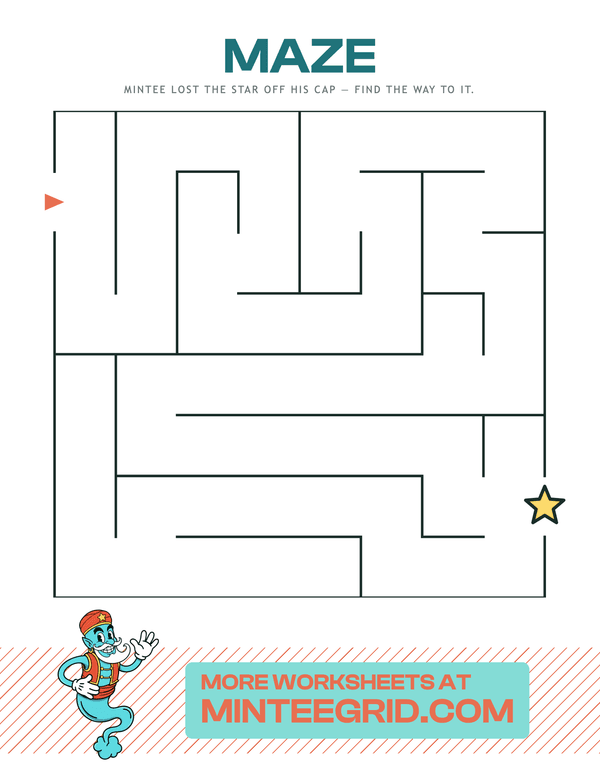
Try it yourself
Classic Maze
One way in, one way out — and never the same maze twice. Mazes · 3+ years.
Related
- How hard should a maze be? — what each width actually does to the page
- A parent's guide to picking difficulty — the longer version, by age
- When square mazes get too easy — changing the shape rather than the setting
- How long should a child work on a worksheet? — when stopping is correct
FAQ
How do I know if a worksheet is too hard for my child?
Watch where they stop. Too hard shows up early — within the first minute, before they have really begun, often with a request for help that is not about anything specific. Too easy shows up at the end, with a sheet finished fast and no interest in another one.
My child says every worksheet is boring. What does that mean?
Usually that it is too hard, not too easy. Boring is the socially safest thing a child can say about something they cannot do, and it is said far more often about difficult work than about simple work.
Should I make worksheets harder as my child gets older?
Only if the current one has stopped being interesting, which is a different signal from being completed. A child who still enjoys a maze at the width they have been using does not need it narrowed on a schedule.
What if I genuinely cannot tell?
Go one step easier. A child who finishes something slightly too simple has had a good five minutes and will do another; a child who fails something slightly too hard often will not pick up the next one at all. The two errors are not symmetrical.