Where mazes came from — and why a labyrinth is not a maze
September 6, 2026 · 7 min read
Children ask where things come from, and mazes have a better answer than most objects on a worksheet. The pattern is genuinely ancient, it turns up independently on four continents, and the thing most people call a labyrinth is not the same object as the thing on the page in front of them.
That last point is worth getting straight first, because it changes how the rest of the story reads.
A labyrinth is not a maze
A labyrinth has one path. It winds, it doubles back, it takes a long time — and it has no junctions at all. You cannot make a wrong turn in a labyrinth because there are no turns to choose from. Walking one is a slow, meditative act, and it always ends in the middle.
A maze has choices. Junctions, branches, dead ends, and the possibility of being wrong. That is a puzzle.
Almost every famous historical "labyrinth" is the first kind. The word got attached to the second kind later and by now the two are used interchangeably, but they are different objects doing different jobs — one is a walk, the other is a problem.
The single-path kind still has a use, and it is a good one for very young children: a trace-the-line sheet at the widest setting is essentially a labyrinth, and a three-year-old who cannot yet handle choices can absolutely handle a long winding path.
The oldest pattern
The classical labyrinth — seven rings, one path, a very particular way of folding back on itself — appears on Cretan coins, on rock carvings in Spain and Italy, in Sardinian tombs, in Indian manuscripts, and cut into the desert by the Hohokam people of what is now Arizona. Some of those are three thousand years apart and half a world from each other.
Nobody knows whether the pattern traveled or whether people kept reinventing it. Both explanations are a bit uncomfortable: it is a very specific design to arrive at twice, and it is a long way to travel.
The Minotaur story is the famous one — a maze under the palace at Knossos, a monster in the middle, a thread to find the way out. No such building has been found. The palace itself is vast and complicated, and a reasonable guess is that visitors described a bewildering building and the story grew. But there is no labyrinth to dig up.
The cathedral floors
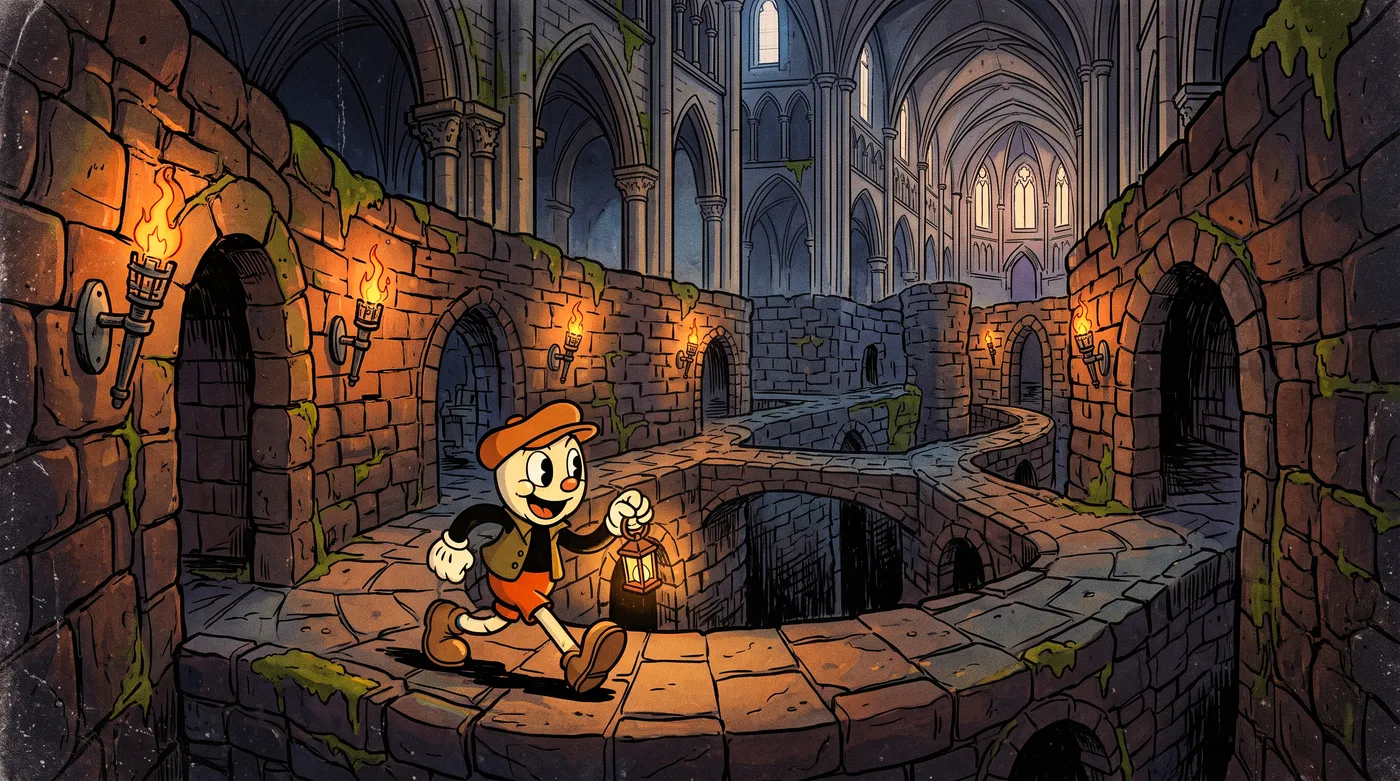
In the twelfth and thirteenth centuries, several French cathedrals had labyrinths set into the stone floor of the nave. The one at Chartres is about forty feet across and still there.
They were walked, not solved. One path, no choices, forty minutes on your knees or your feet, ending in the middle. What they were for is not documented anywhere contemporaneously, which has not stopped four centuries of confident explanation — a substitute pilgrimage, a penance, a meditation. The honest answer is that we do not know, and the labyrinths themselves say nothing.
Worth knowing because it is a case where a shape a child recognizes from a worksheet is also a real object, in a real building, that people have been walking for eight hundred years.
The hedges
The branching maze — the kind with dead ends, the kind on our sheets — is the young one. It shows up in European gardens from the sixteenth century onward, as entertainment. The Hampton Court maze near London was planted around 1700 and is still open; it is small, it is trapezoidal, and it defeats a surprising number of adults.
The shift from labyrinth to maze is a shift in purpose. A single path is for walking and thinking. A branching one is for being wrong, backtracking, and eventually winning — which is a game, and is why the second kind arrived alongside pleasure gardens rather than churches.

The cornfields
The newest chapter is thirty years old. The first corn maze was cut in Annville, Pennsylvania in 1993, and by the 2000s there were hundreds every fall across the US.
The reason it caught on is practical rather than cultural. The field is going to be harvested anyway, the crop is tall enough to be a wall by August, and a design can be cut with GPS and a tractor in a day. It is the cheapest large maze anyone has ever built, and unlike a hedge it is a different design every year.

What to tell a child
Three things, in this order, are enough:
- People have been drawing this shape for longer than there has been writing. It is older than most things in a museum.
- The old ones had one path. You could not get lost. You walked to the middle and back out and that was the point.
- The one you are holding can be got wrong. That is what makes it a puzzle instead of a walk.
The third point tends to land, because it reframes the dead end as the entire reason the sheet exists.
Lifehack: print one sheet at the widest setting and one at the narrowest and put them side by side. The wide one is close to a labyrinth — few choices, mostly a path. The narrow one is unmistakably a maze. Seeing the difference is faster than explaining it.
The shapes on this site, and where they come from
- Circular maze — the closest thing here to the classical labyrinth's rings, though ours has real junctions
- Spiral maze — the oldest shape in human art, wound in to a single center
- Classic maze — the hedge maze, on paper
- Star, heart and diamond — no history at all, and no pretense of one
Try it yourself
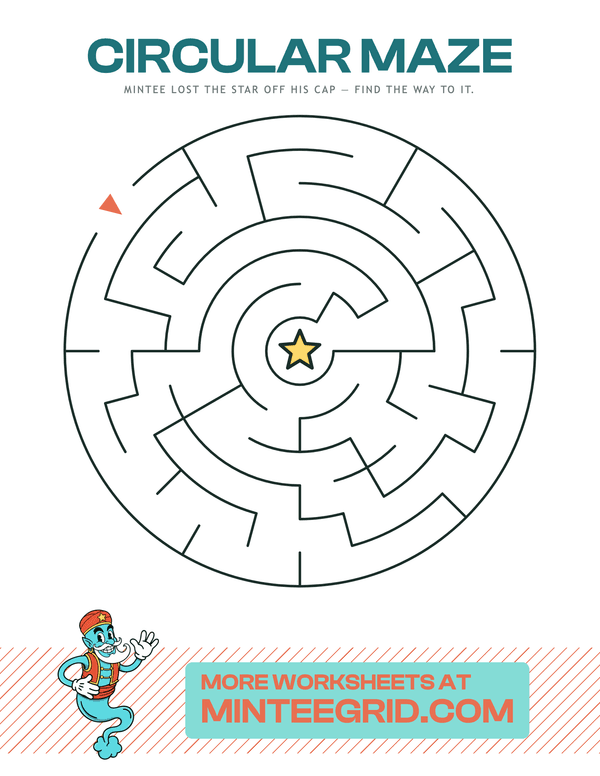
Circular Maze
Rings and radial corridors — work your way in to the middle. Mazes · 4+ years.
Related
- Mazes that already exist in nature — the ones nobody designed
- Circular mazes vs square ones — how a ring maze actually solves
- Spiral mazes — the shape that turns up everywhere
- What a maze actually teaches — the honest list
FAQ
What is the difference between a maze and a labyrinth?
A labyrinth has one path with no choices — you cannot get lost in it, you simply walk to the middle. A maze has junctions and dead ends and can be got wrong. Almost every historical 'labyrinth' is the first kind, including the ones on cathedral floors, which is why the two words are not interchangeable even though everyone uses them that way.
How old are mazes?
The single-path labyrinth pattern turns up on coins, pottery and rock carvings from around three to four thousand years ago, in places as far apart as Crete, Sardinia, India and Arizona. The branching puzzle maze — the kind with dead ends — is far younger, and mostly a European garden idea from the last five hundred years.
Was there a real labyrinth of the Minotaur?
No building has ever been found that matches the story. The palace at Knossos on Crete is enormous and complicated, and one plausible explanation is that visitors described a confusing building and the story grew from it — but that is a guess, not a discovery.
Why are corn mazes a recent thing?
The first one was cut in Pennsylvania in 1993. They took off because the ingredients were already there — a field that is going to be harvested anyway, and a shape that can be cut with GPS and a tractor in an afternoon.